How it works: pick a test below. Exam mode runs the real time limit and scores you at the end; study mode shows the right answer and the reasoning after each question. Every question has a diagram or a short scenario and a worked explanation. Without choosing a mode, you can simply read each question and open its answer.
Bennett-style test: 55 questions, 25 minutes
Built to the BMCT-II format: 55 picture questions with three choices each, covering pulleys and levers, hydraulics, forces and motion, structures, gears and belts, gravity, acoustics and optics, center of gravity, electricity, heat and shape and volume.
Question 1
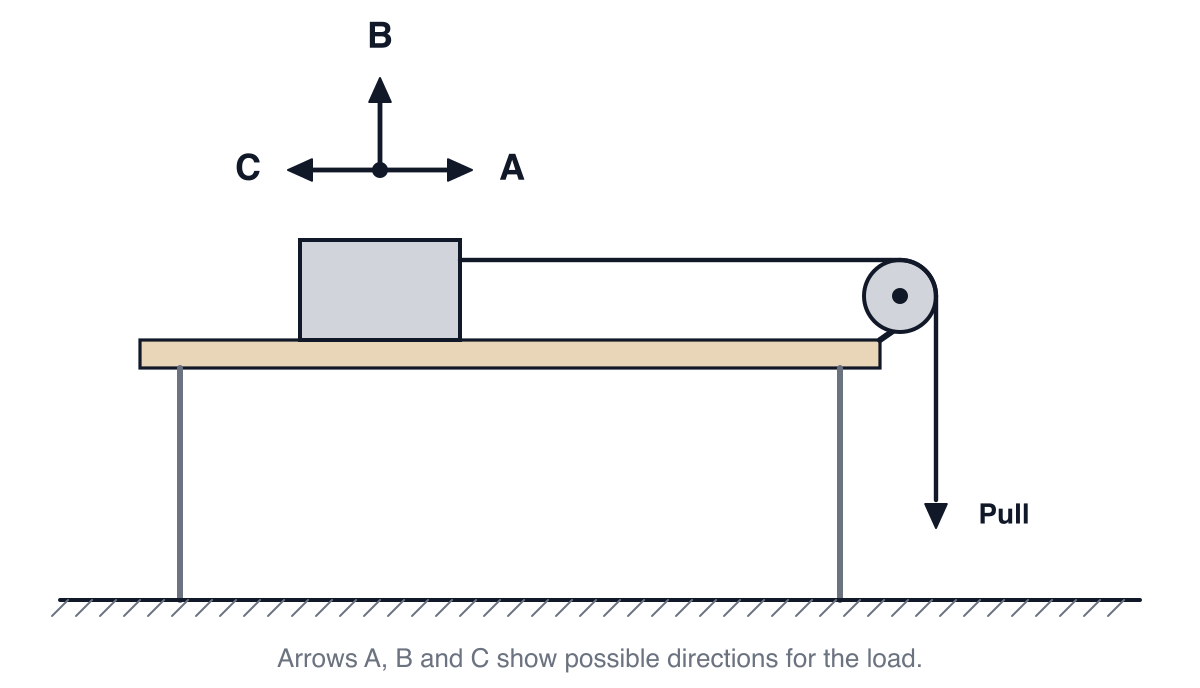
The rope is pulled as shown. Which arrow shows the way the load moves?
Show answer and working
Answer: A. Arrow A. The rope runs from the block to the pulley at the table edge. Pulling down on the hanging end draws the rope over the pulley, so the block slides toward the pulley. Arrow A shows that direction.
Question 2
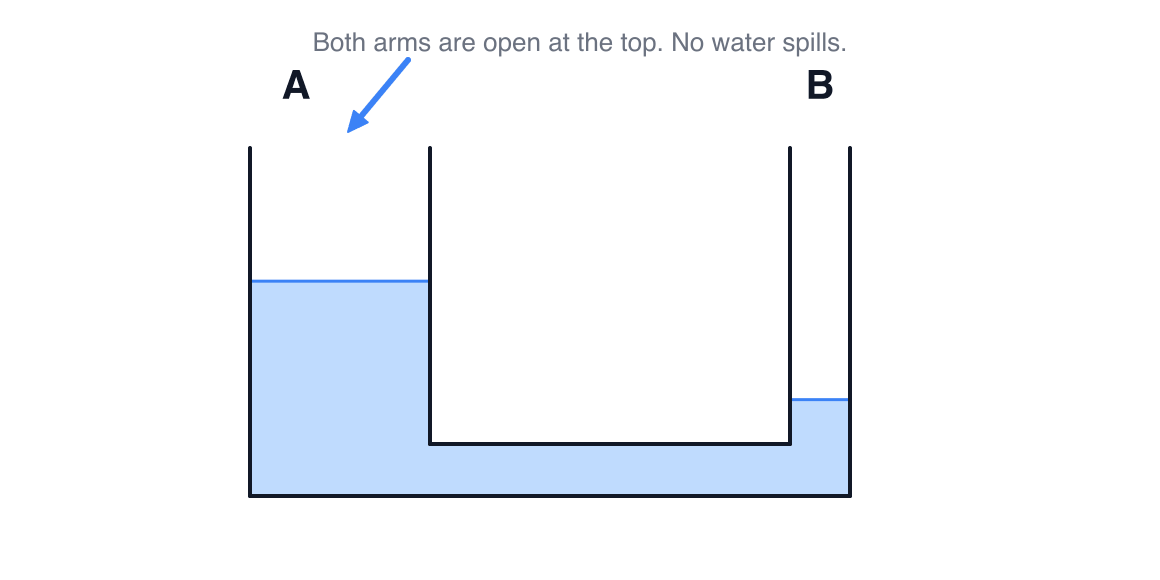
The picture shows water being poured into arm A. When the pouring stops and the water settles, in which arm is the water surface higher?
Show answer and working
Answer: C. The same height in both. Water in connected vessels that are open to the air settles at the same level in every arm, because the pressure at the bottom must match on both sides. The width, slope or shape of an arm makes no difference, so once the flow stops the surfaces are the same height, even though arm A stood higher while it was being filled.
Question 3
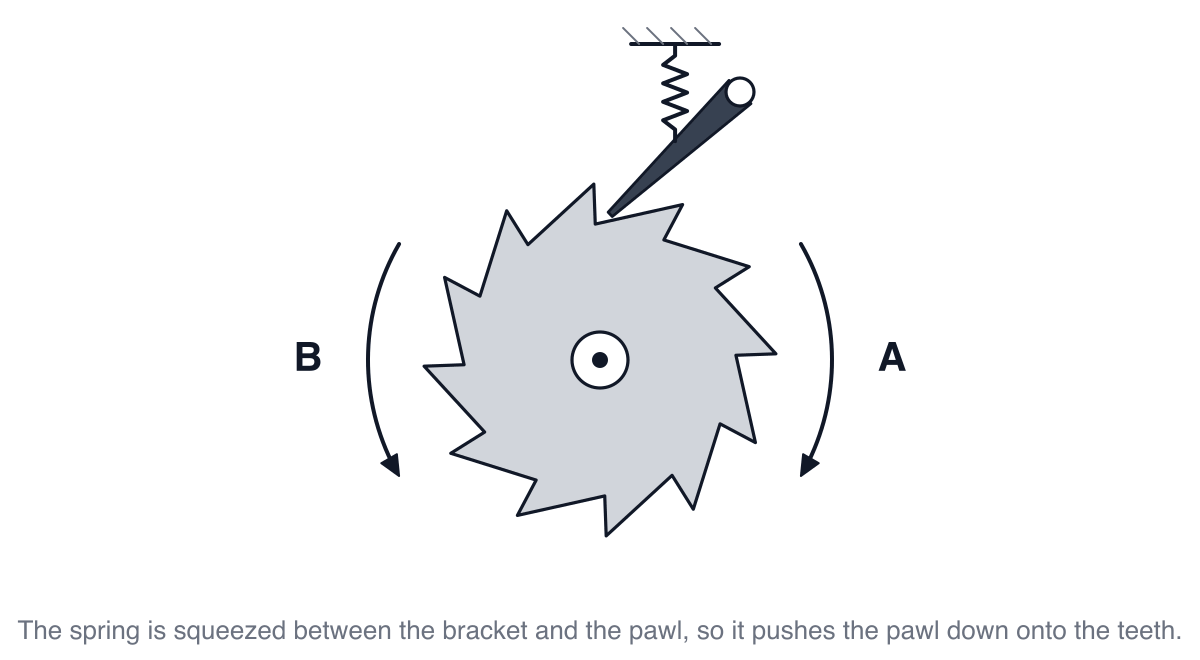
A spring pushes the pawl against the teeth. In which direction can the wheel be turned?
Show answer and working
Answer: B. Direction B only. The pawl's tip rests against the steep face of a tooth. Turning the wheel clockwise drives that face into the pawl and jams it. Turning it counterclockwise (direction B) slides the sloped backs of the teeth under the pawl, which lifts and clicks over each tooth, so the wheel turns only that way.
Question 4
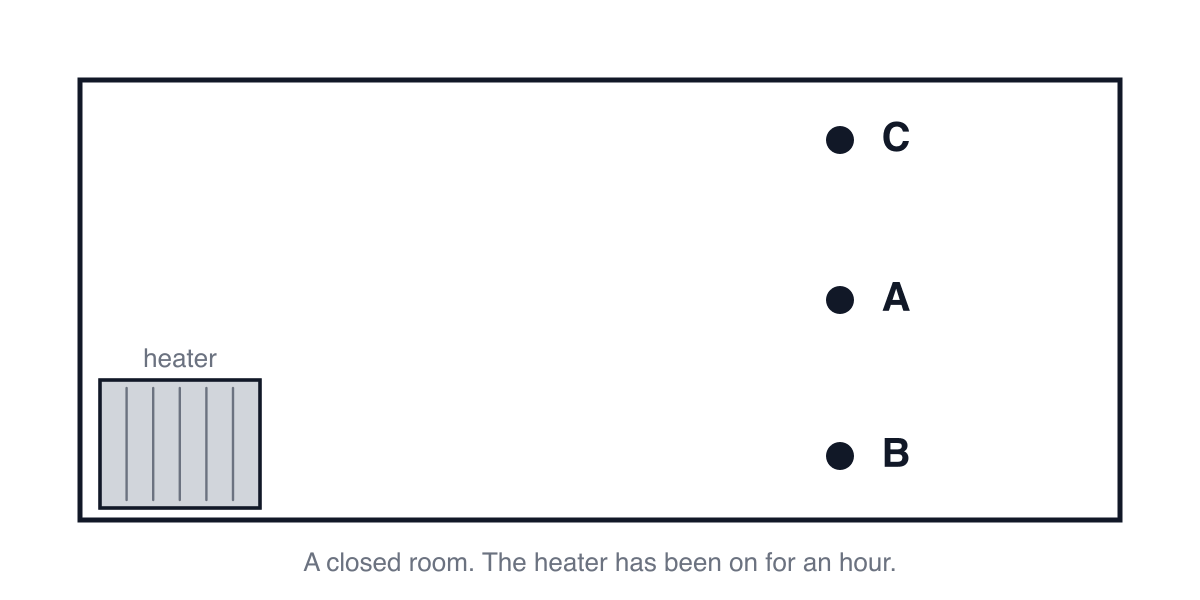
At which point is the air warmest?
Show answer and working
Answer: C. Point C. Air warmed by the heater expands, becomes less dense and rises, while cooler, denser air sinks. Warm air collects under the ceiling, so point C, the highest, has the warmest air.
Question 5
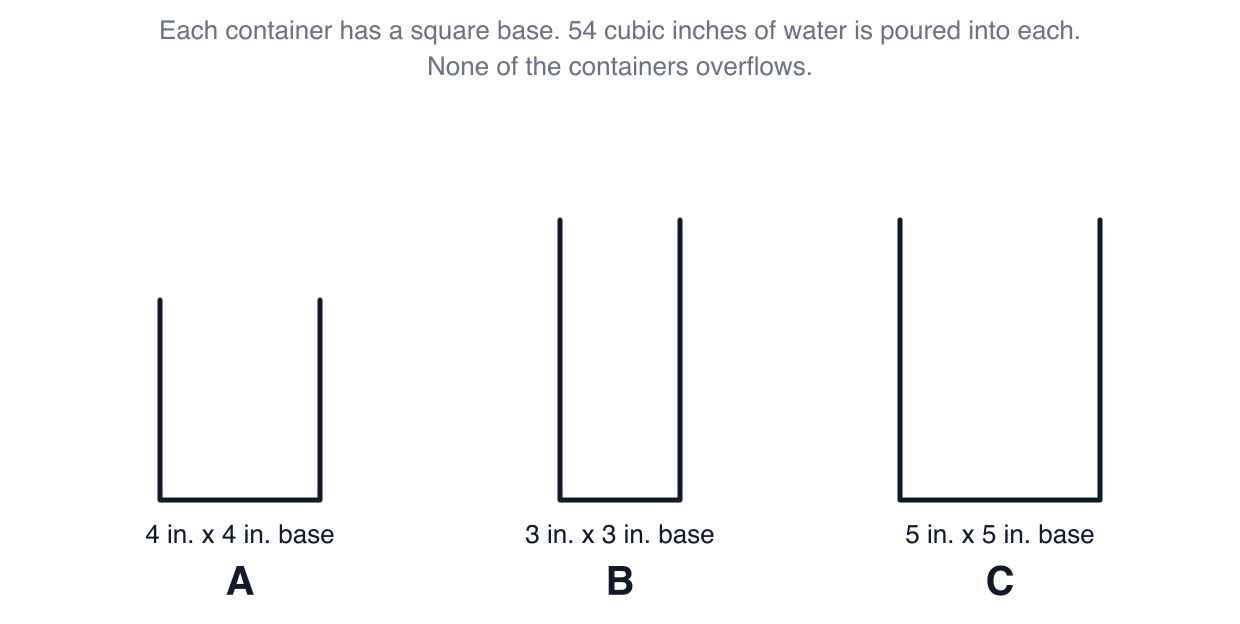
In which container will the water be shallowest?
Show answer and working
Answer: C. Container C. Water depth is the volume divided by the base area, so the same volume is shallowest on the largest base. Base areas: A 16 sq in., B 9 sq in., C 25 sq in. Container C has the largest base.
Question 6
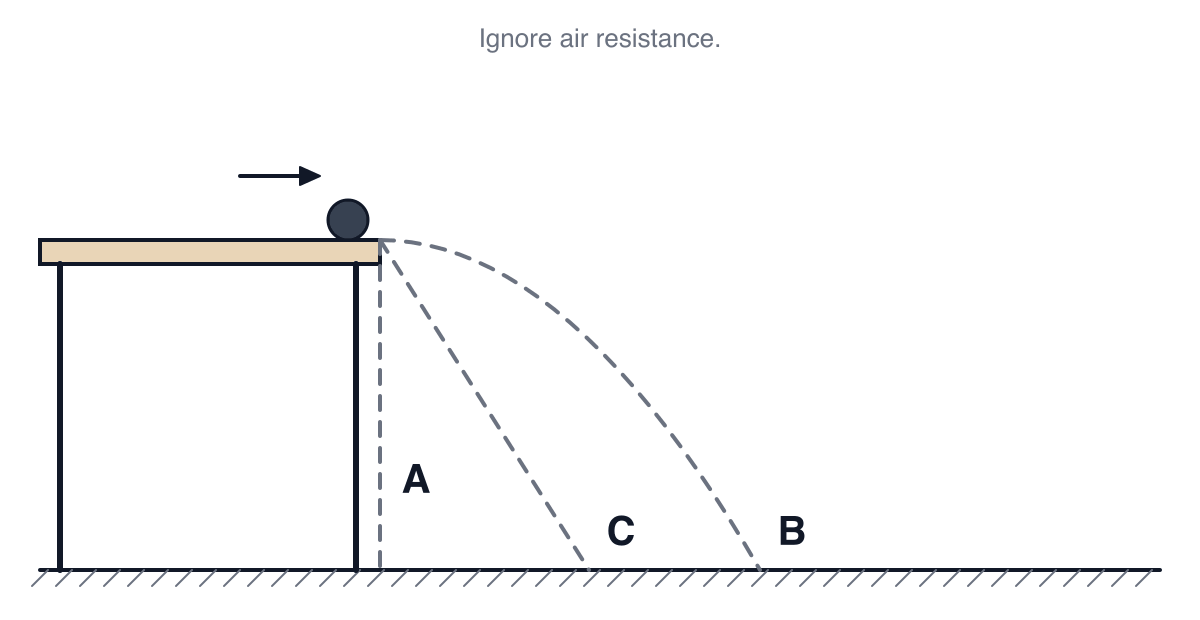
A ball rolls off the edge of the table. Which path does the ball follow?
Show answer and working
Answer: B. Path B. The ball keeps its sideways speed after it leaves the edge, while gravity makes it move downward faster and faster. The result is a curve that starts out level and bends steadily downward, path B. It does not drop straight down, and it does not travel in a straight slanted line.
Question 7
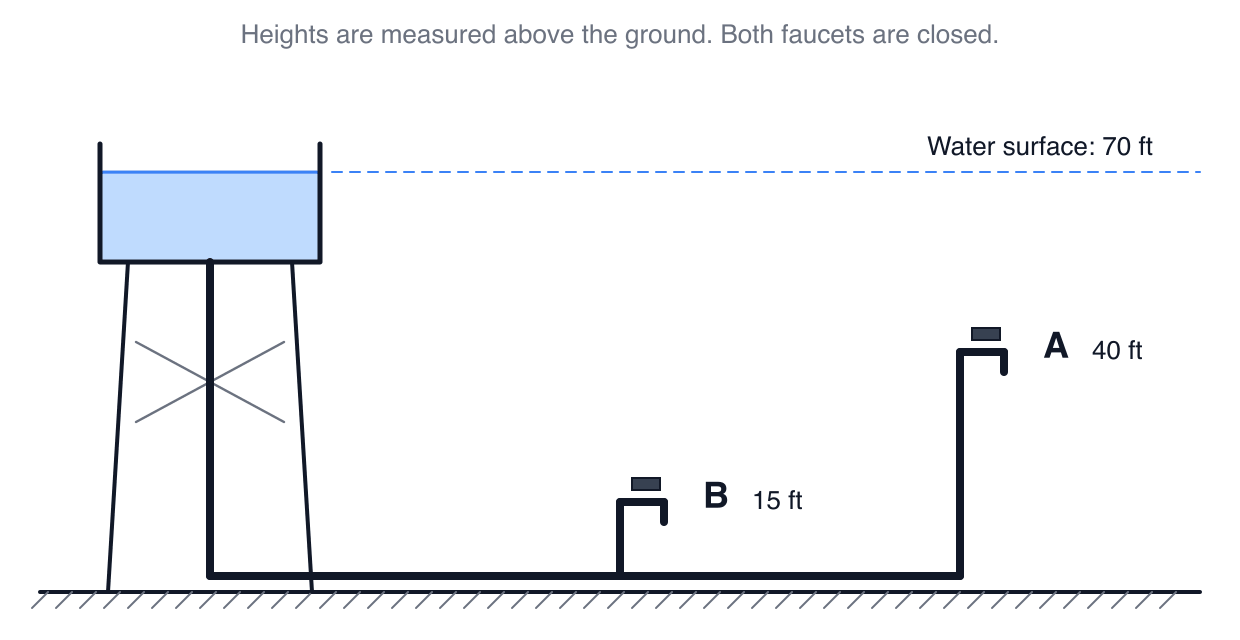
At which faucet is the water pressure greater?
Show answer and working
Answer: B. Faucet B. With the faucets closed the water is still, so the pressure at each faucet depends only on how far it sits below the tank's water surface at 70 ft. Faucet B is 55 ft below it and faucet A only 30 ft, so faucet B has the greater pressure.
Question 8
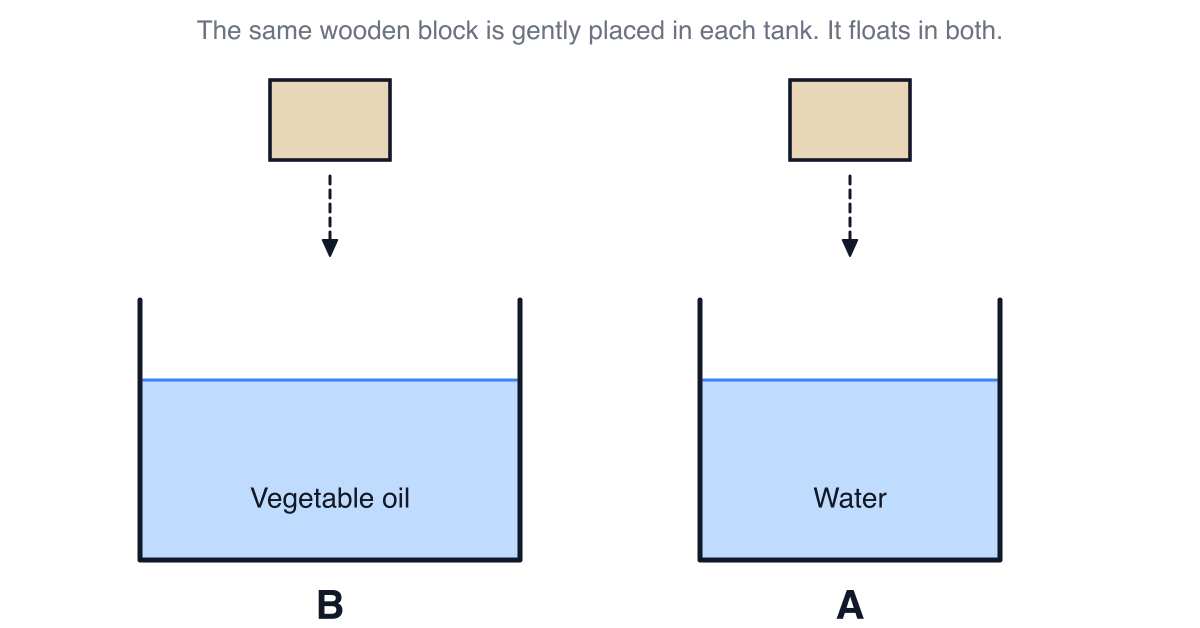
In which tank will more of the block stick out above the surface?
Show answer and working
Answer: A. Tank A. A floating block sinks until the liquid it pushes aside weighs as much as the block. Water is denser than vegetable oil, so less of it has to be pushed aside and the block rides higher in tank A.
Question 9
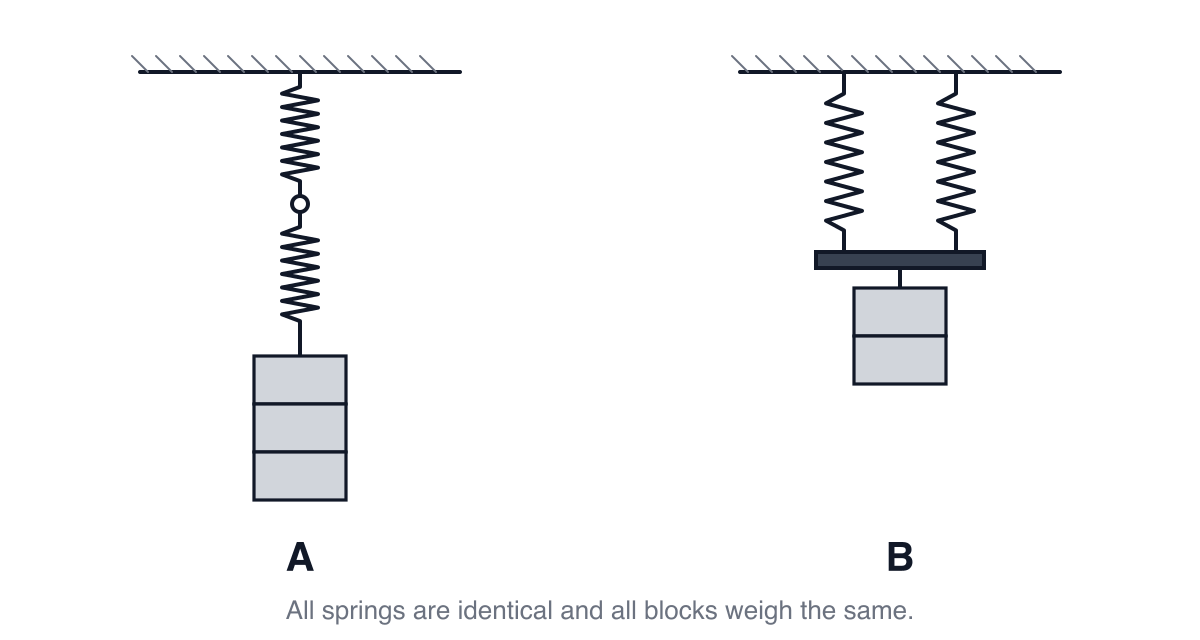
The blocks are hung on the springs. In which arrangement do the blocks move down farther?
Show answer and working
Answer: A. Arrangement A. Count in units, where one block on one spring stretches it 1 unit. In A, two springs hang one below the other, each carries the full 3 blocks and stretches 3, so the blocks drop 6 units. In B, two springs side by side share 2 blocks, so each stretches only 1 unit and the blocks drop just 1 unit. The blocks in arrangement A move down farther. Springs in a chain add their stretch; springs side by side share the load.
Question 10
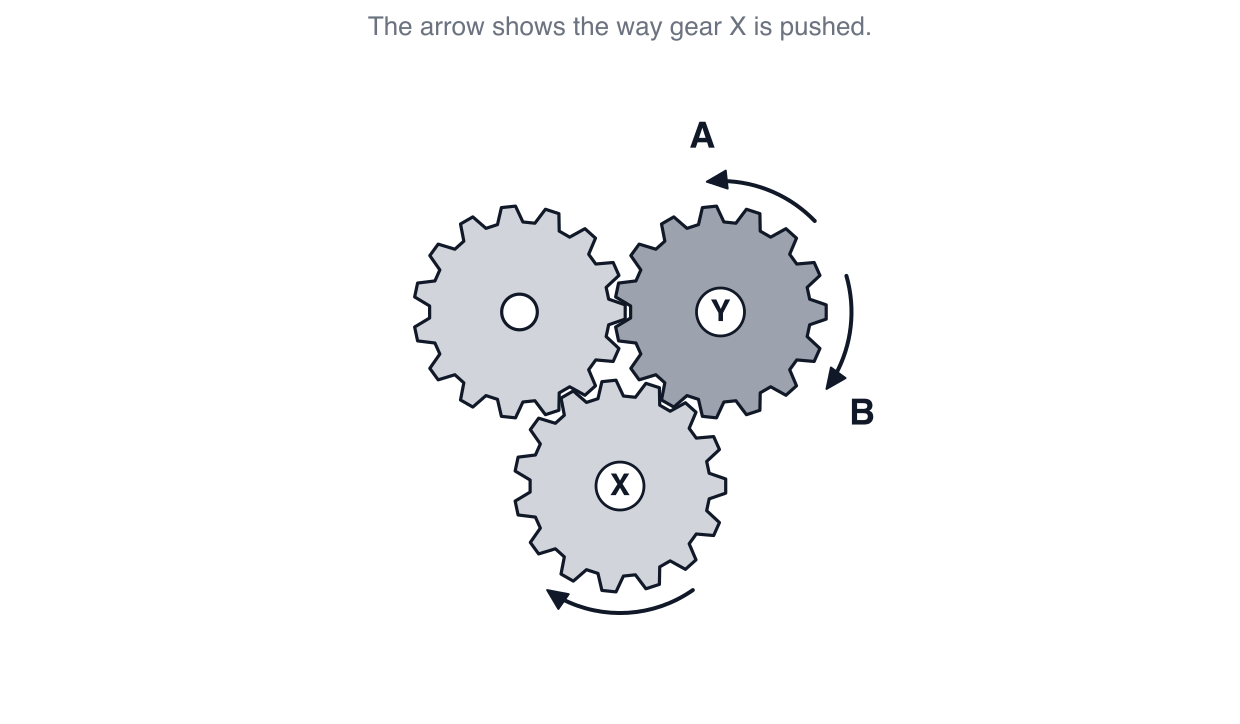
Which way does gear Y turn?
Show answer and working
Answer: C. It cannot turn. Meshing gears turn in opposite directions. The three gears form a closed loop in which each one meshes with both of the others, so each would have to turn both ways at once. The gears lock and none of them can turn.
Question 11
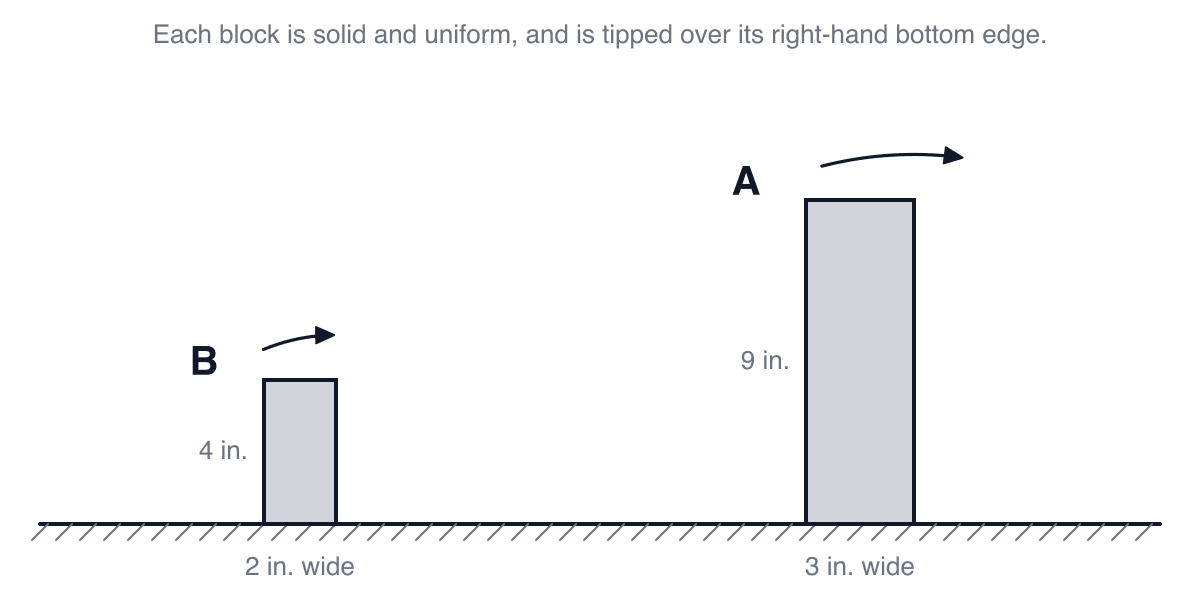
Which block can be tilted farther before it falls over?
Show answer and working
Answer: B. Block B. A block falls once its center of gravity passes over the edge it pivots on. A block that is wide for its height can lean farther: block A (3 in. wide, 9 in. tall) can lean about 18° and block B (2 in. wide, 4 in. tall) about 27°. So block B can be tilted farther.
Question 12
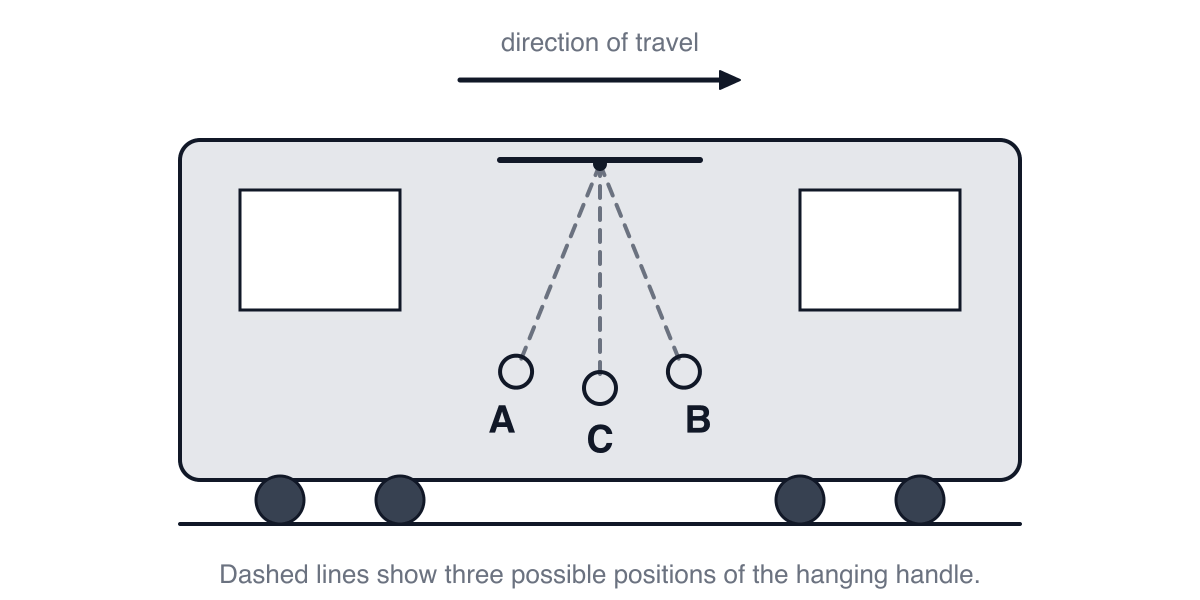
The train is moving to the right and is braking hard. Which position does the hanging handle take?
Show answer and working
Answer: B. Position B. The handle tends to keep moving at the train's old speed. When the train slows down, the handle carries on forward, so it swings toward the front of the train, the right, position B.
Question 13
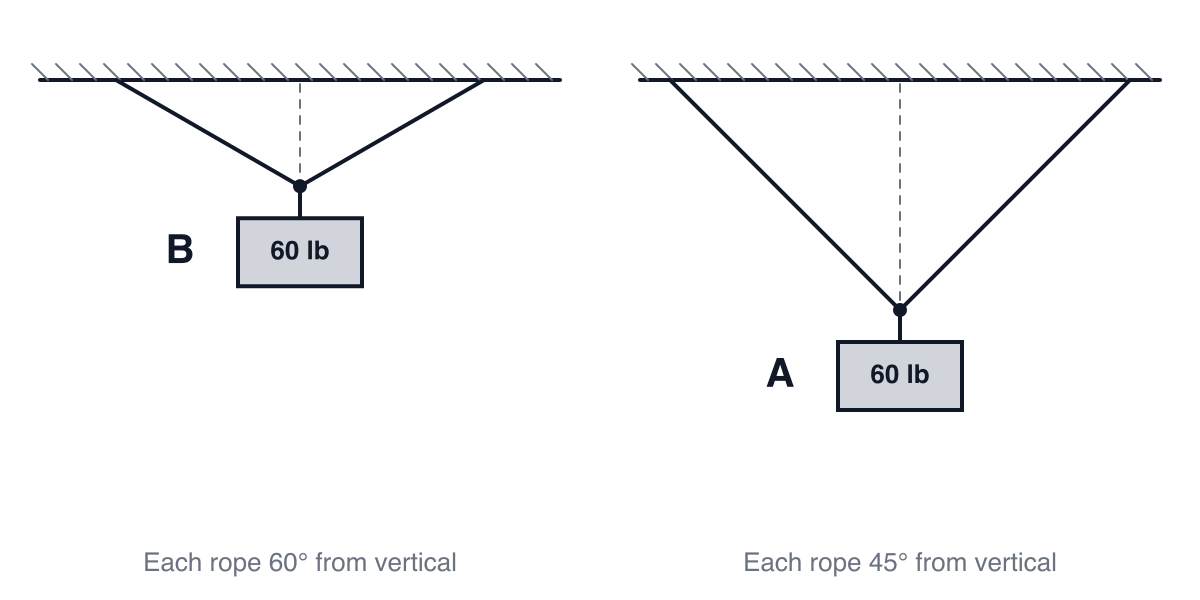
Both loads weigh the same. In which picture does each rope pull harder (carry more tension)?
Show answer and working
Answer: B. Picture B. A rope that leans away from vertical spends part of its pull sideways, so the more the ropes lean, the harder each must pull to hold the same load. At 45° each rope in picture A carries about 42 lb; at 60° each rope in picture B carries about 60 lb. So picture B has the greater tension.
Question 14
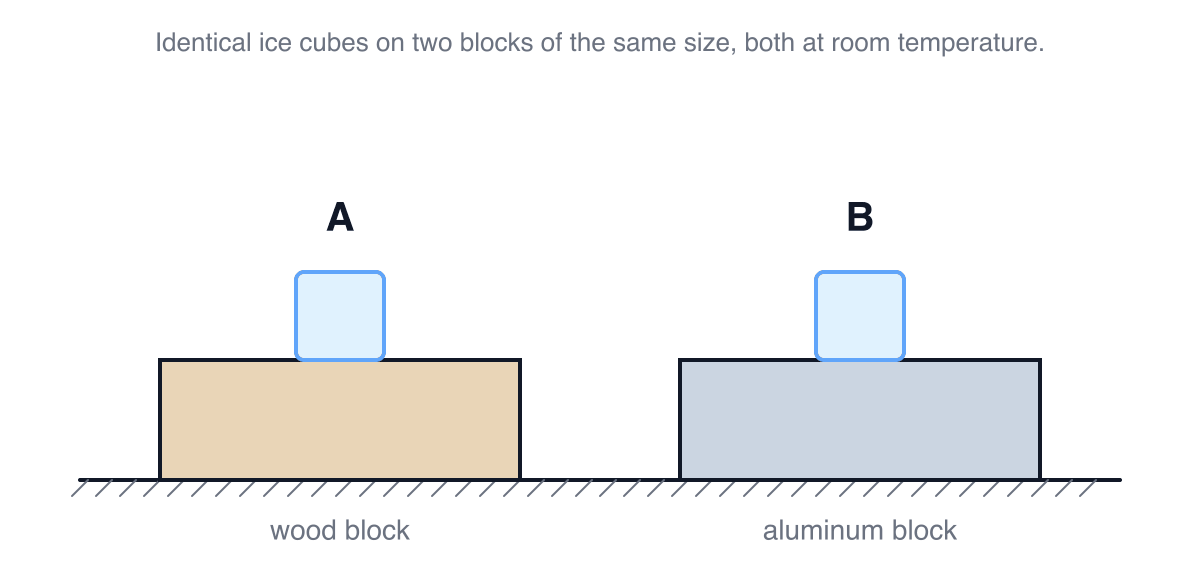
Which ice cube melts first?
Show answer and working
Answer: B. The cube on block B. Both blocks start at room temperature, but aluminum is a good conductor of heat: it keeps drawing heat from the whole block into the ice. Wood is a poor conductor, so heat reaches its cube slowly. The cube on block B melts first, even though the metal may feel colder to the touch.
Question 15
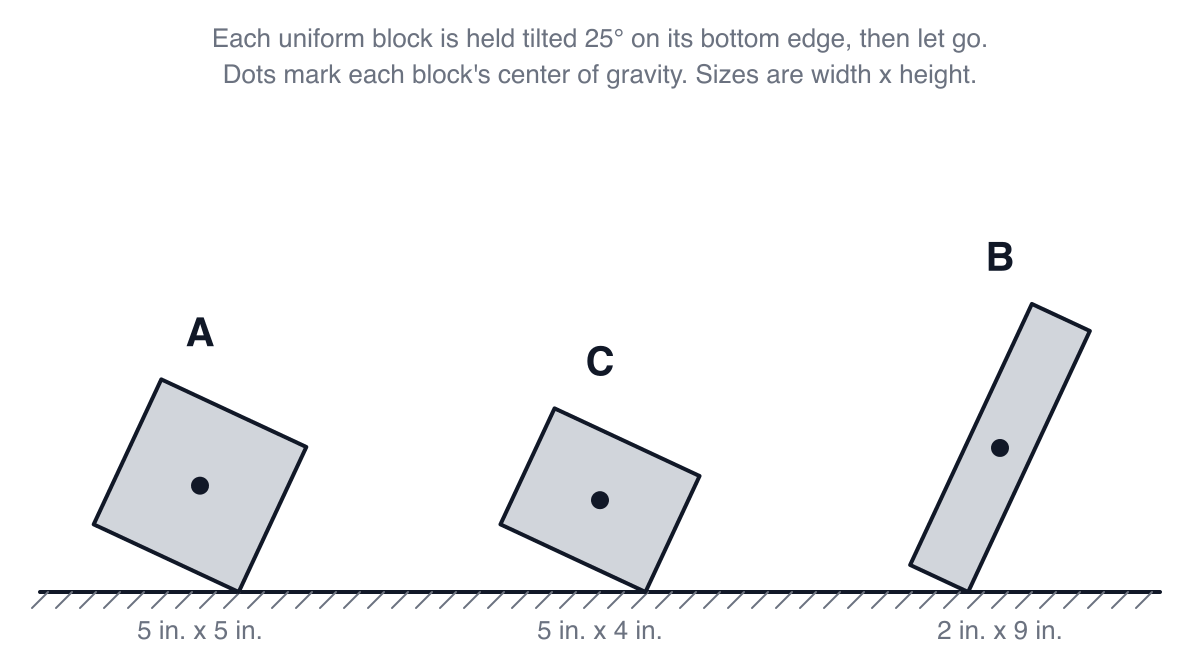
Which block falls over onto its side instead of dropping back onto its base?
Show answer and working
Answer: B. Block B. A tilted block drops back if its center of gravity is still above its base, and tips over if the center of gravity has moved past the edge it rests on. At 25° that happens only to a block narrower than about 0.47 times its height. Block B, 2 in. wide and 9 in. tall, is that narrow, so it falls over; the other two are wide enough to drop back.
Question 16
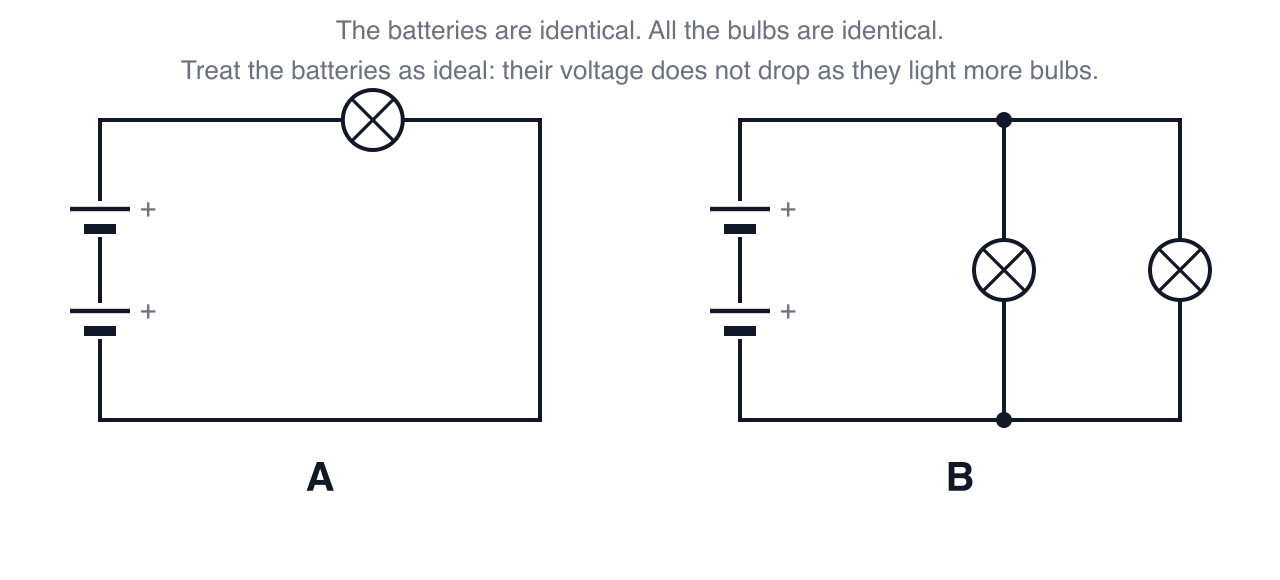
In which circuit does each bulb glow more brightly?
Show answer and working
Answer: C. Both the same. In circuit A the single bulb is connected straight across the battery and gets its full voltage. In circuit B the two bulbs are in parallel, each on its own branch straight across the battery, so each gets the full voltage. So every bulb in both circuits gets the full battery voltage and glows equally brightly. Adding bulbs in parallel draws more current from the battery, but it does not dim each bulb.
Question 17
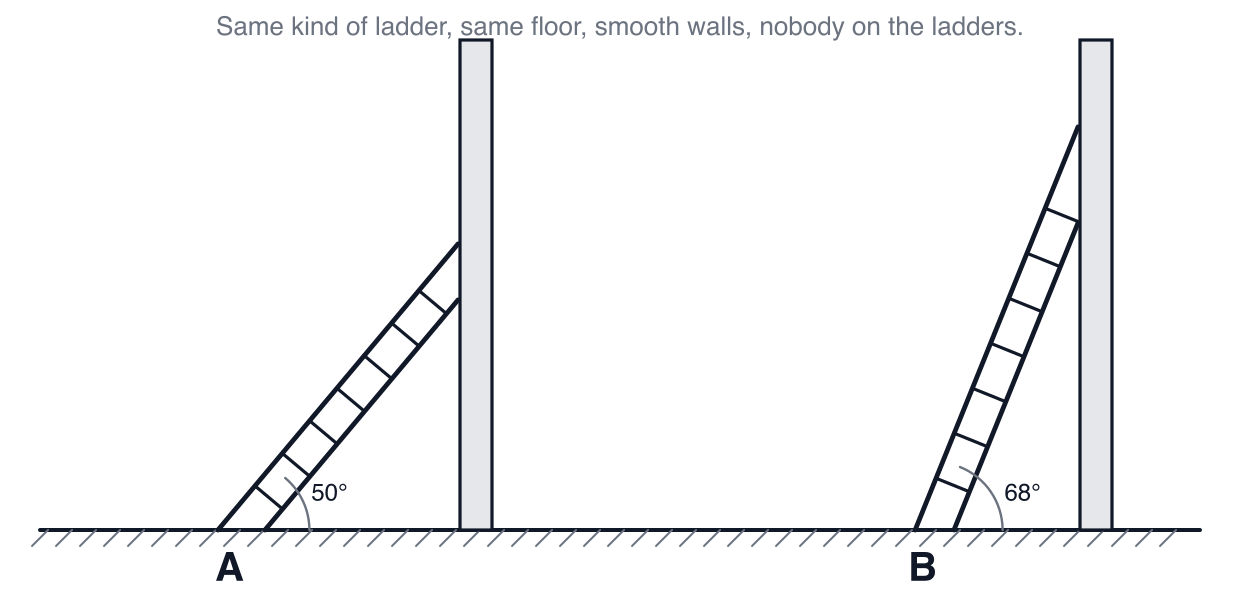
Which ladder is more likely to slide out at its foot?
Show answer and working
Answer: A. Ladder A. The farther a ladder's foot stands out from the wall, the harder the wall pushes it outward and the more grip the floor must supply. Ladder A leans at a flatter angle (50 degrees to the ground against 68), so it is more likely to slide out.
Question 18
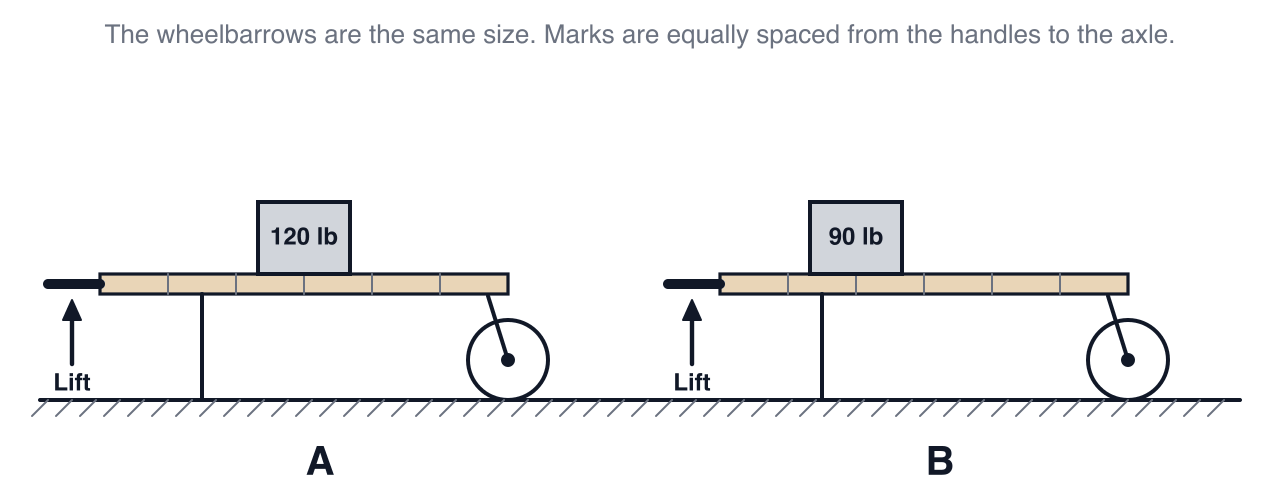
Which wheelbarrow needs the smaller lift at the handles?
Show answer and working
Answer: C. Both need the same lift. The wheel's axle is the pivot and the handles are 6 marks from it. Lift = load x load distance / 6. A: 120 x 3 / 6 = 60 lb. B: 90 x 4 / 6 = 60 lb. The lifts are equal: the heavier load sits closer to the wheel by just the right amount.
Question 19
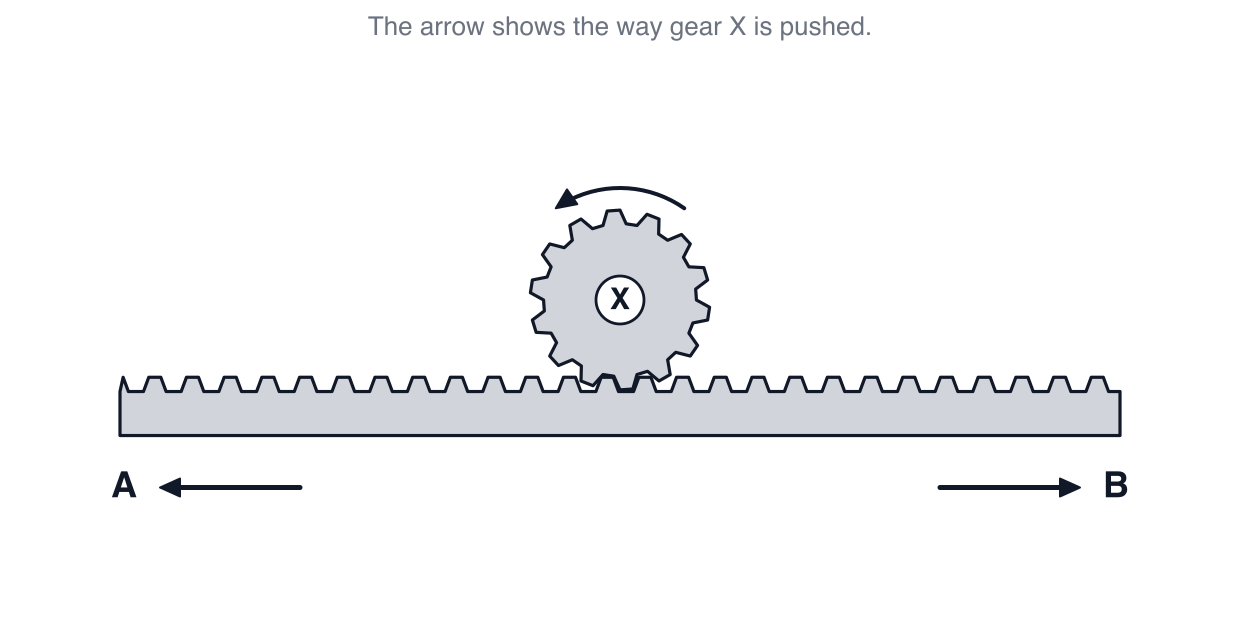
Which way does the rack move?
Show answer and working
Answer: B. Direction B. The rack moves the same way as the teeth of gear X where they touch it. Gear X turns counterclockwise and its bottom edge moves right, so the rack moves right, direction B.
Question 20
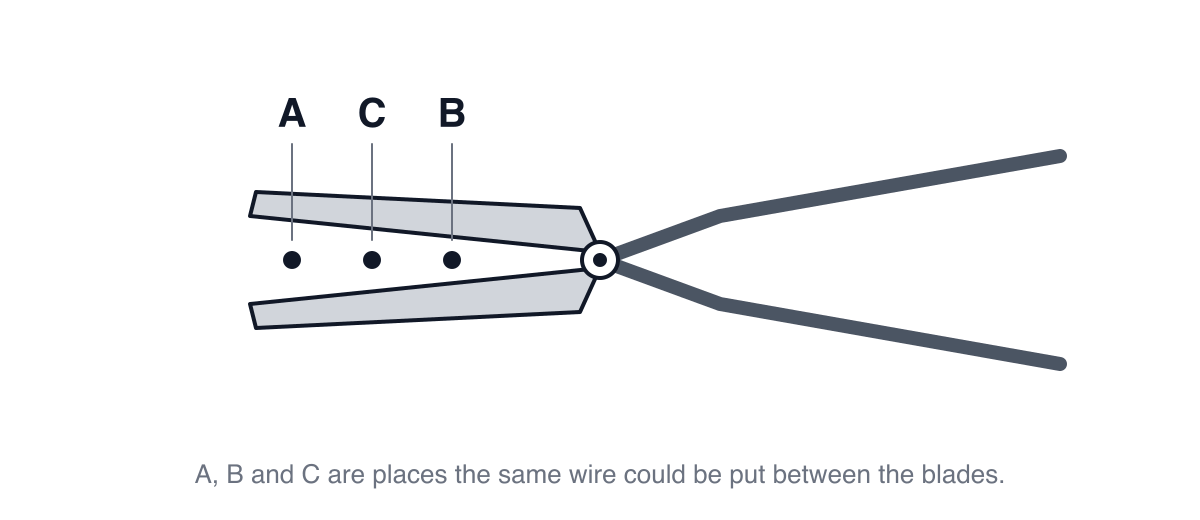
The same wire is to be cut with the same cutters. At which place does cutting it take the most effort?
Show answer and working
Answer: A. At A. Cutters are levers with the pivot at the joint. The farther the wire is from the pivot, the less the squeeze on the handles is multiplied at the blades. A is farthest from the pivot, so it takes the most effort; B, next to the joint, takes the least.
Question 21
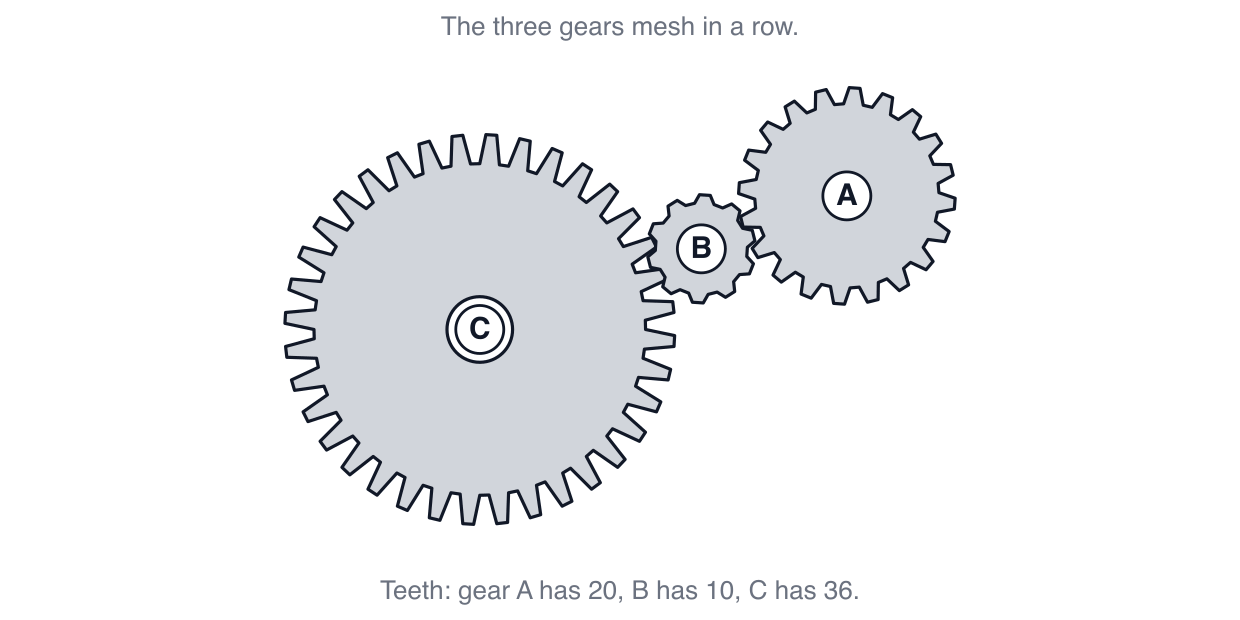
Which gear turns the most times per minute?
Show answer and working
Answer: B. Gear B. Meshing gears move the same number of teeth past each other every second, so the gear with the fewest teeth has to turn the most times. Gear B is the smallest, with 10 teeth, so it turns fastest. Its place in the row does not matter.
Question 22
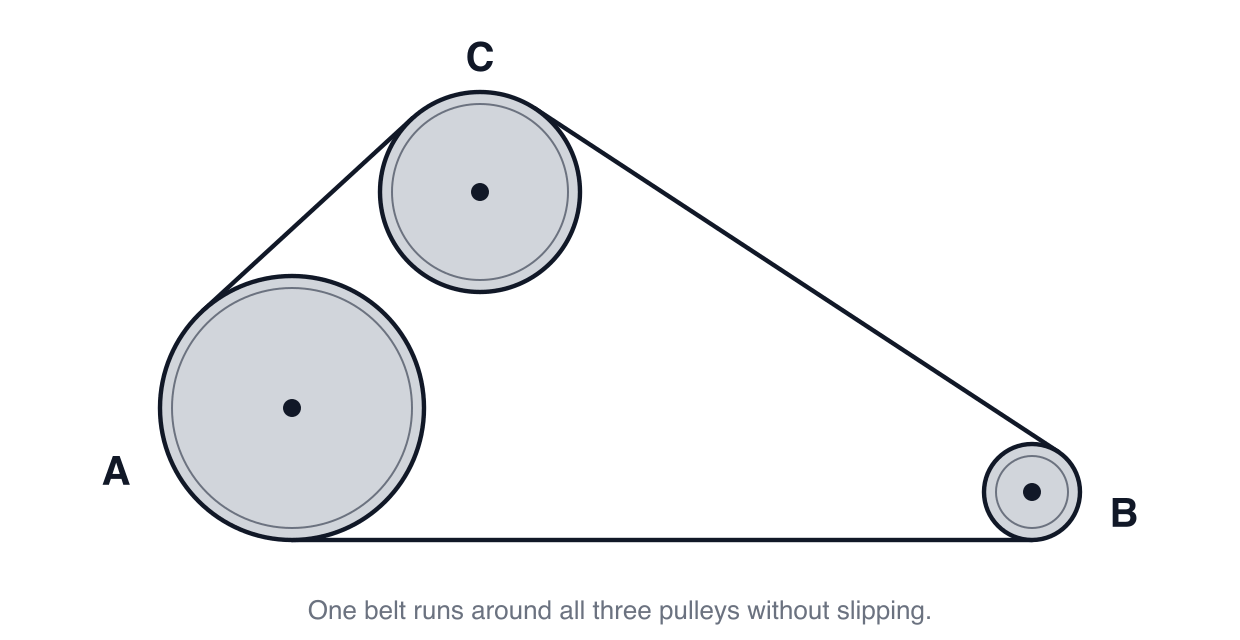
Which pulley turns the fewest times per minute?
Show answer and working
Answer: A. Pulley A. The belt moves at the same speed over every pulley, so the largest pulley needs the fewest turns to pass the same length of belt. Pulley A is the largest, so it turns slowest.
Question 23
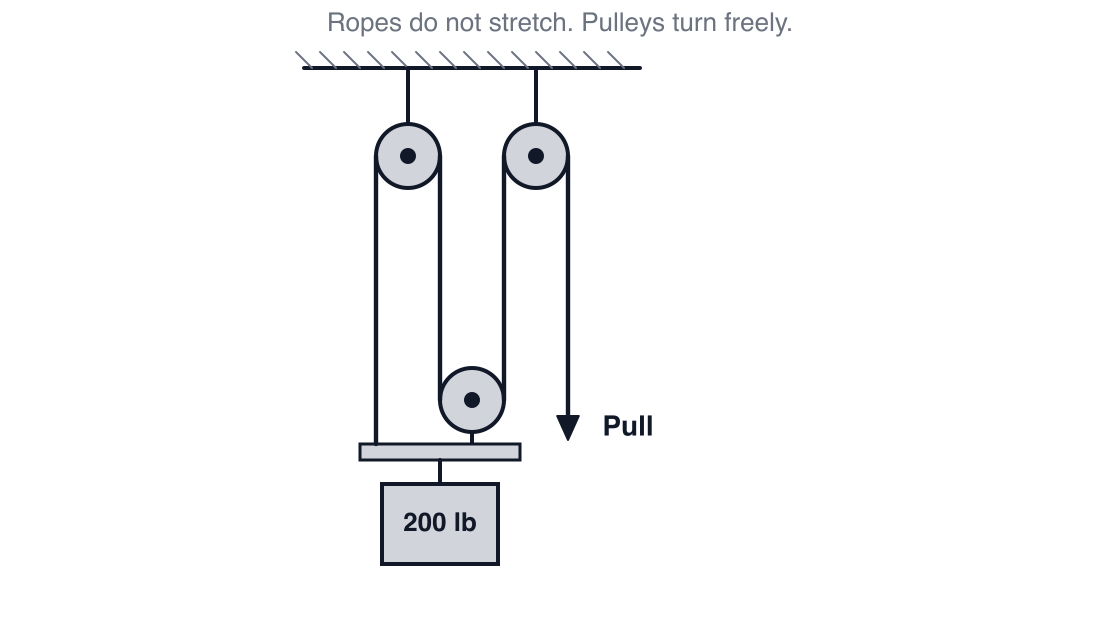
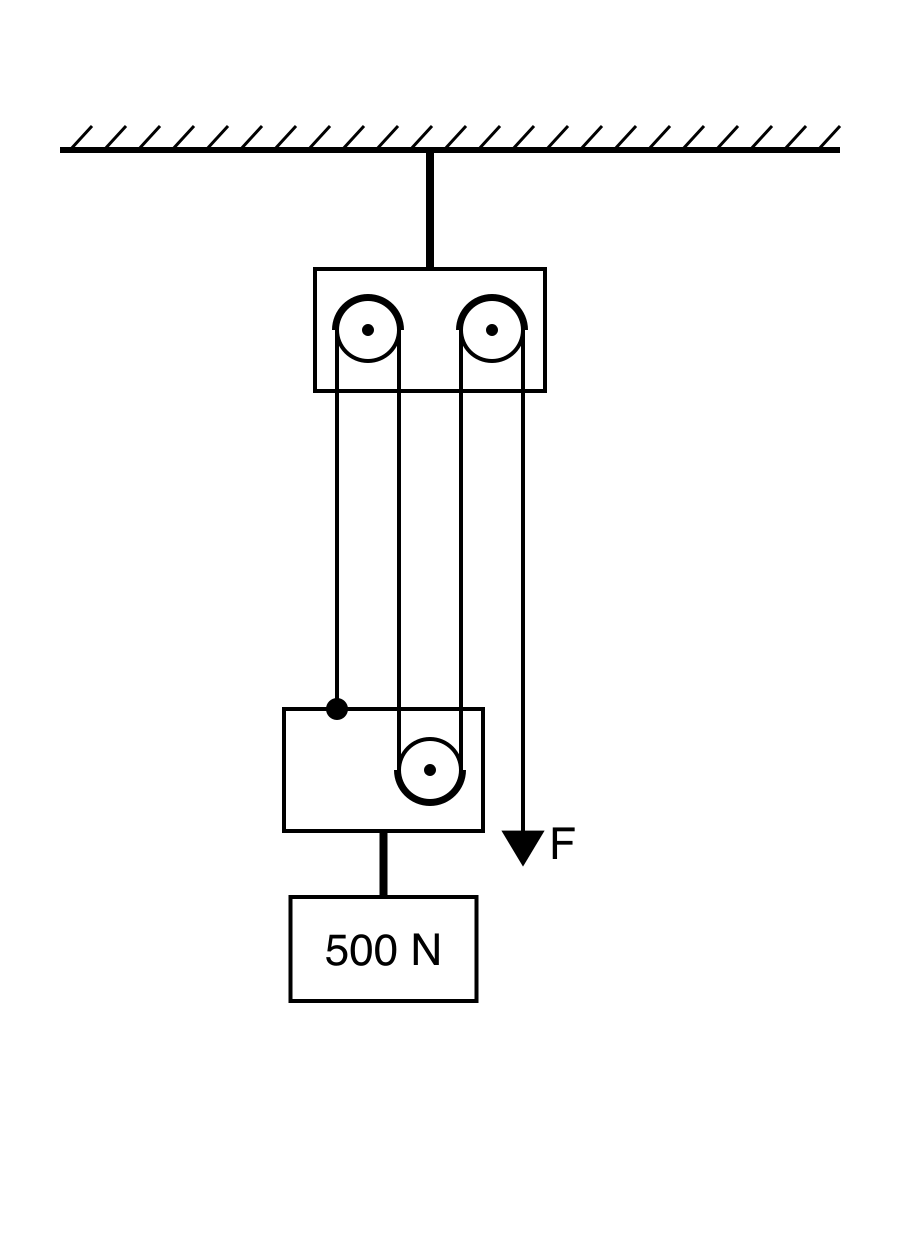
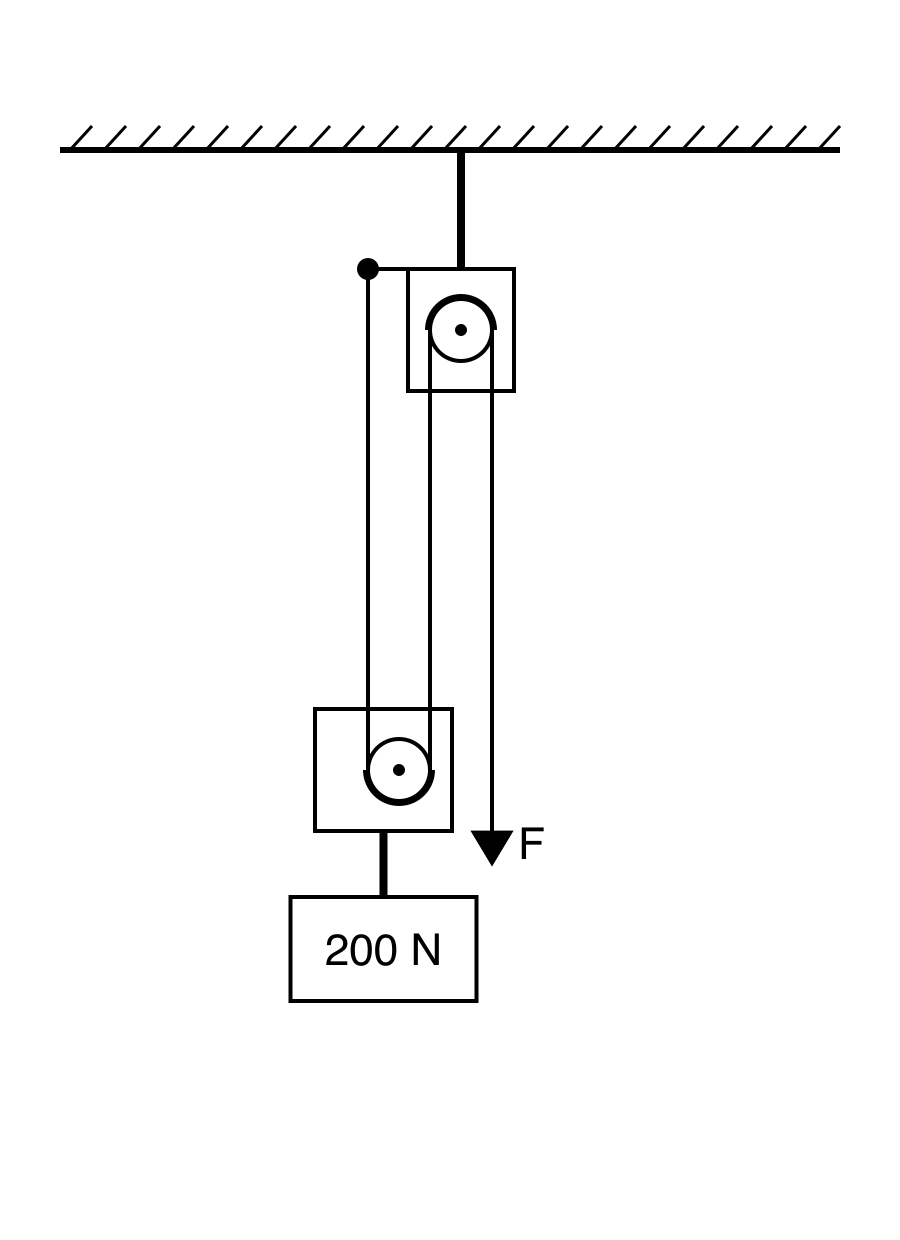
The pull end of the rope is moved 24 ft. How far does the weight rise?
Show answer and working
Answer: A. 8 ft. 3 rope segments hold the moving load. To raise the load 1 ft, each of those segments must shorten by 1 ft, so the pull end travels 3 ft. Moving the pull end 24 ft therefore raises the load 24 / 3 = 8 ft. The easier pull is paid for with extra rope travel.
Question 24
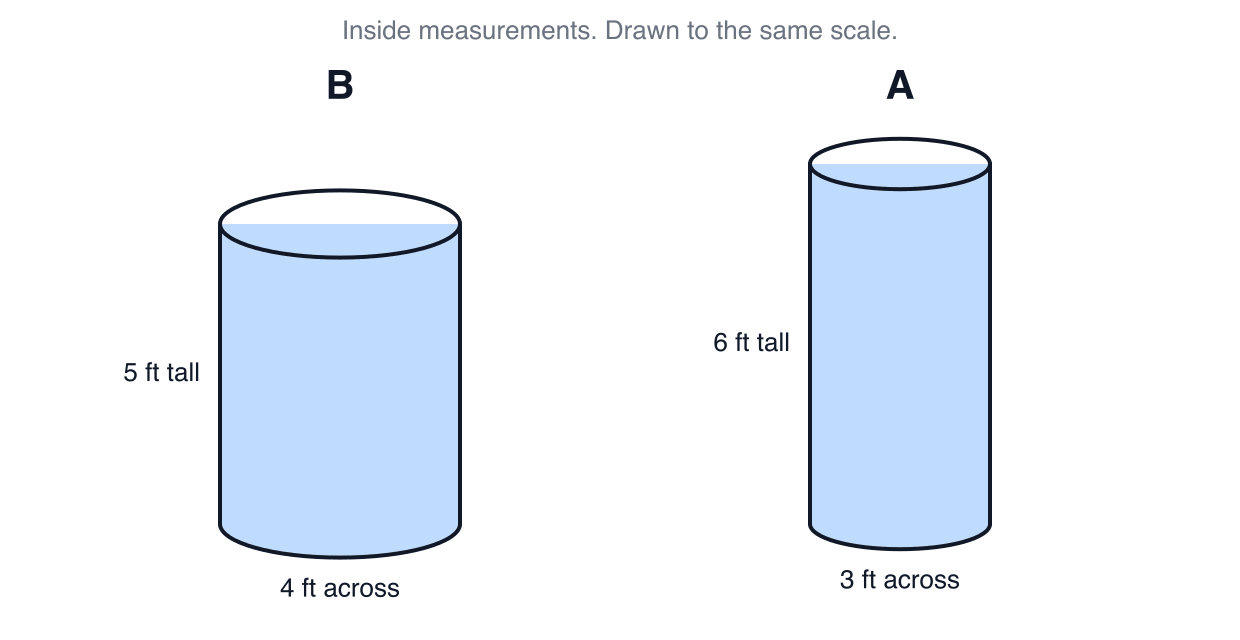
Which tank holds more water?
Show answer and working
Answer: B. Tank B. A round tank holds (width x width x height) times the same pi/4 factor, so compare width x width x height. Tank A: 3 x 3 x 6 = 54 units. Tank B: 4 x 4 x 5 = 80 units. Tank B holds more, whatever its height.
Question 25
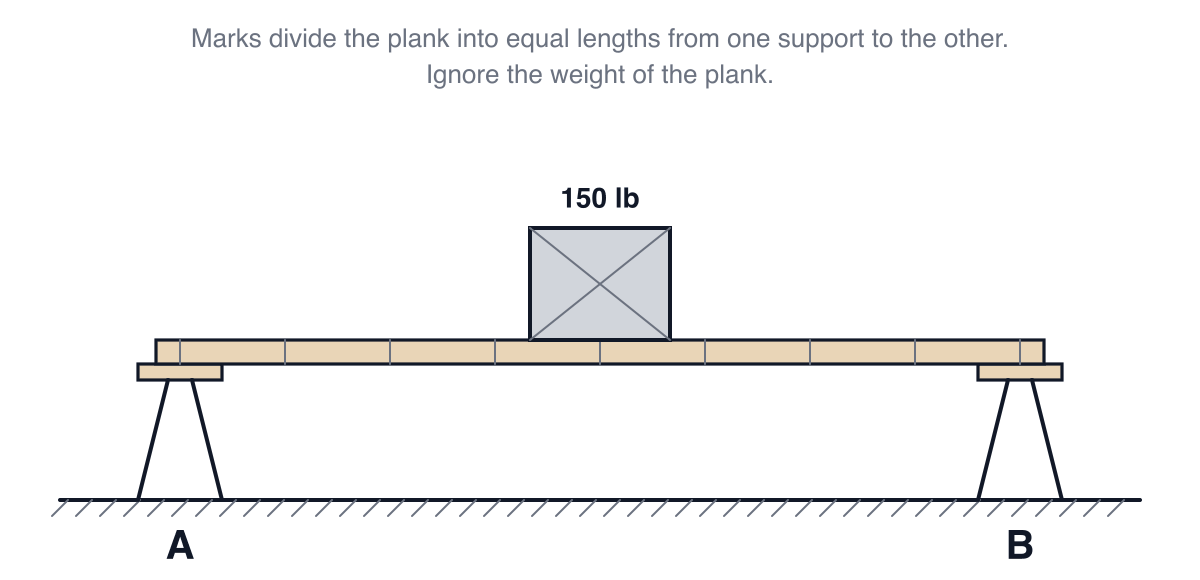
Which support carries more of the crate's weight?
Show answer and working
Answer: C. Both carry the same. The crate sits exactly halfway between the supports, so each carries half of it, 75 lb. A support's share only grows as the load moves closer to it.
Question 26
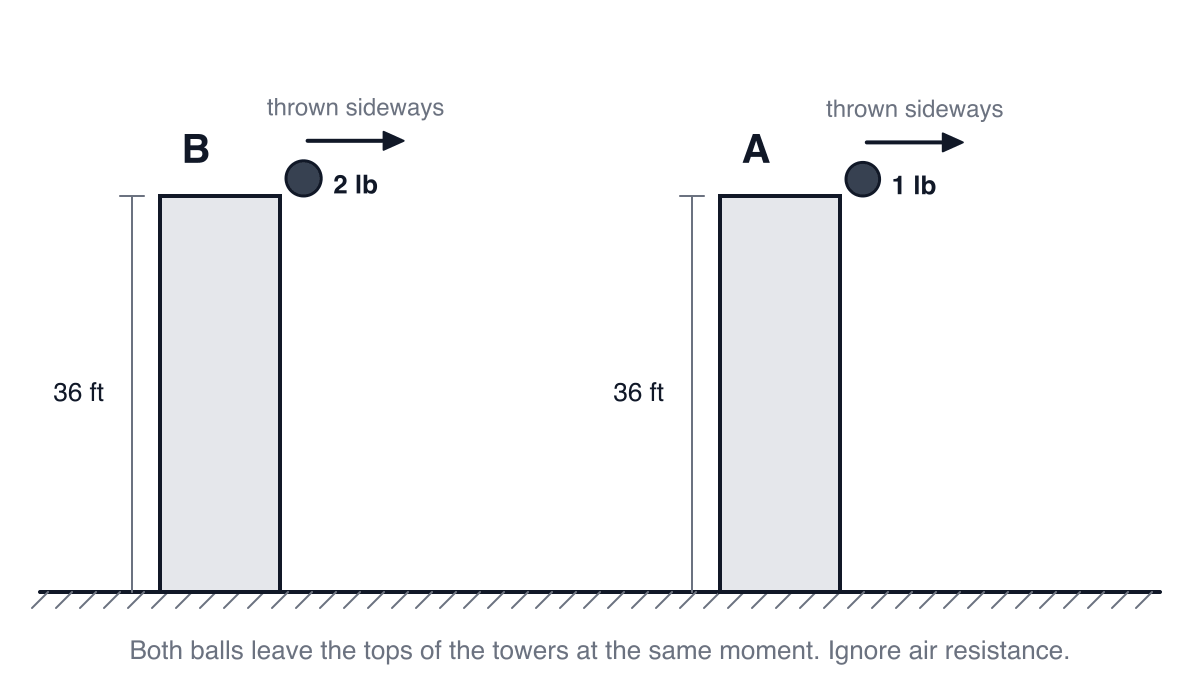
Which ball hits the ground first?
Show answer and working
Answer: C. They land at the same time. How long a ball takes to fall depends only on the height it falls from. Both fall 36 ft, which takes 1.5 s, so they land together. A ball's weight and any sideways speed do not change its fall time.
Question 27
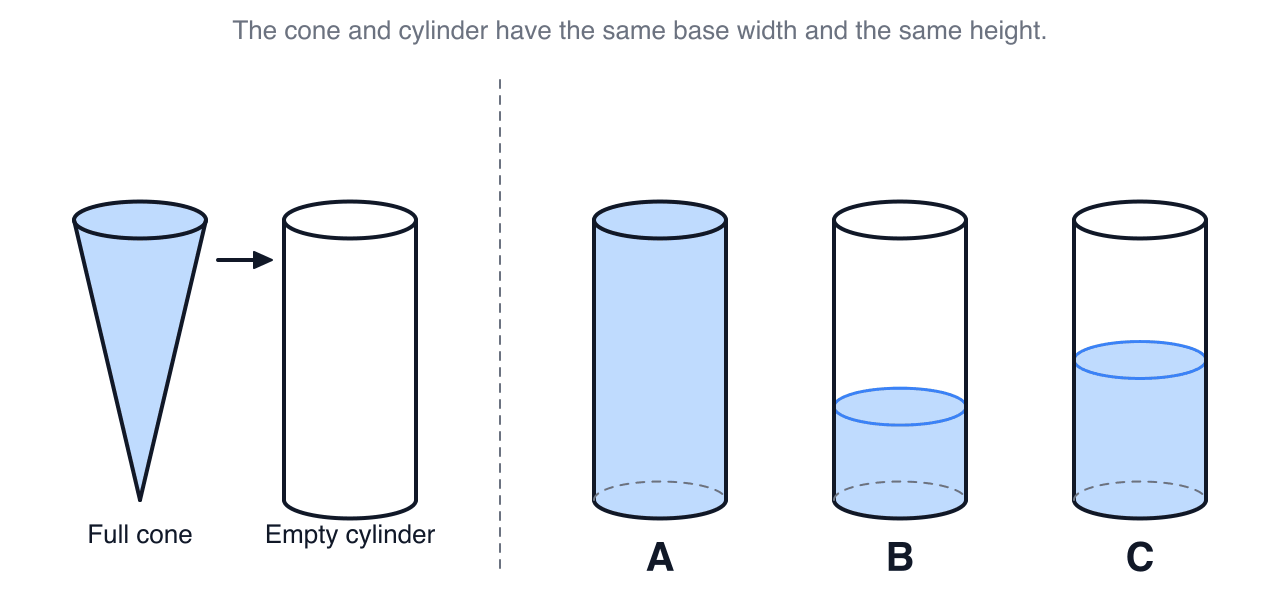
The water in the full cone is poured into the empty cylinder. Which drawing shows the result?
Show answer and working
Answer: B. Drawing B. A cone holds exactly one third of the volume of a cylinder with the same base and height. So the cone's water fills the cylinder to one third of its height, as in drawing B.
Question 28
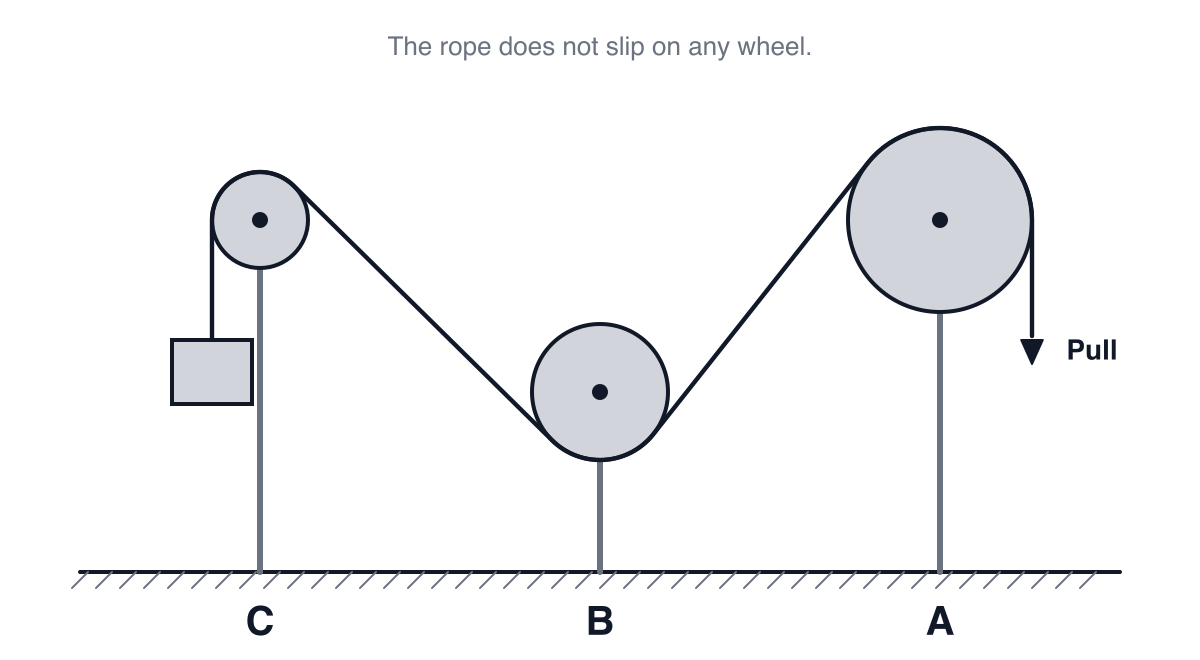
The rope is pulled and runs over all three wheels. Which wheel turns slowest?
Show answer and working
Answer: A. Wheel A. The rope moves the rim of every wheel at the same speed. A large wheel has a long rim, so it makes fewer turns for the same length of rope. Wheel A is the largest, so it turns slowest. From smallest to largest: C, B, A.
Question 29
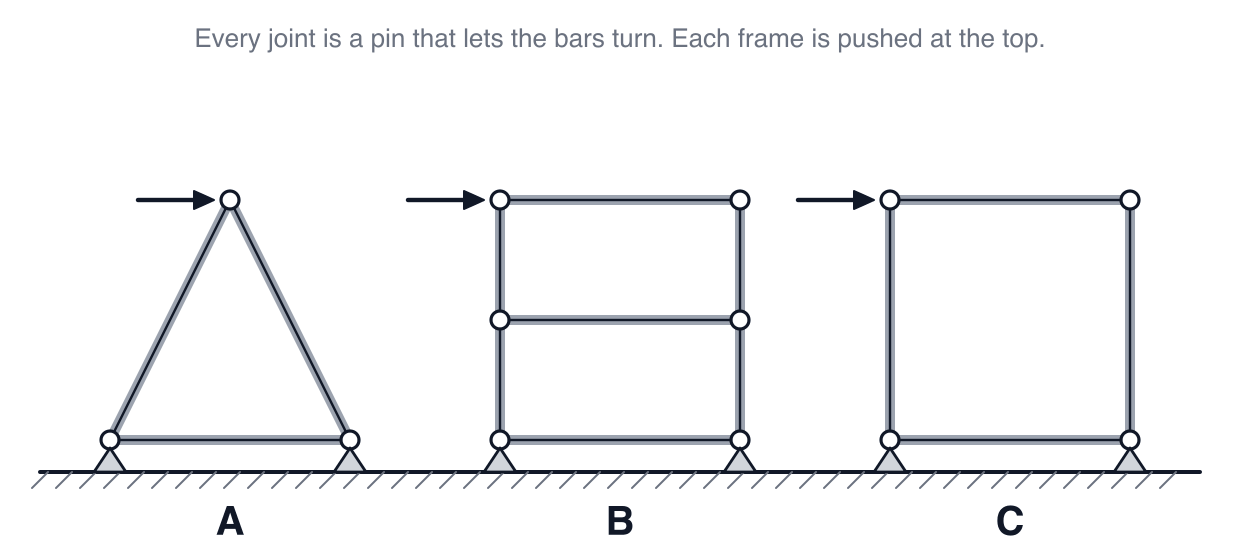
Which frame keeps its shape when it is pushed sideways?
Show answer and working
Answer: A. Frame A. A triangle of bars cannot change shape unless a bar changes length, so only frames made of triangles are rigid. Frame A is rigid because it is a triangle. Frame C and frame B are built from four-sided panels, which fold over into parallelograms at the pinned joints, even with an extra bar across them.
Question 30
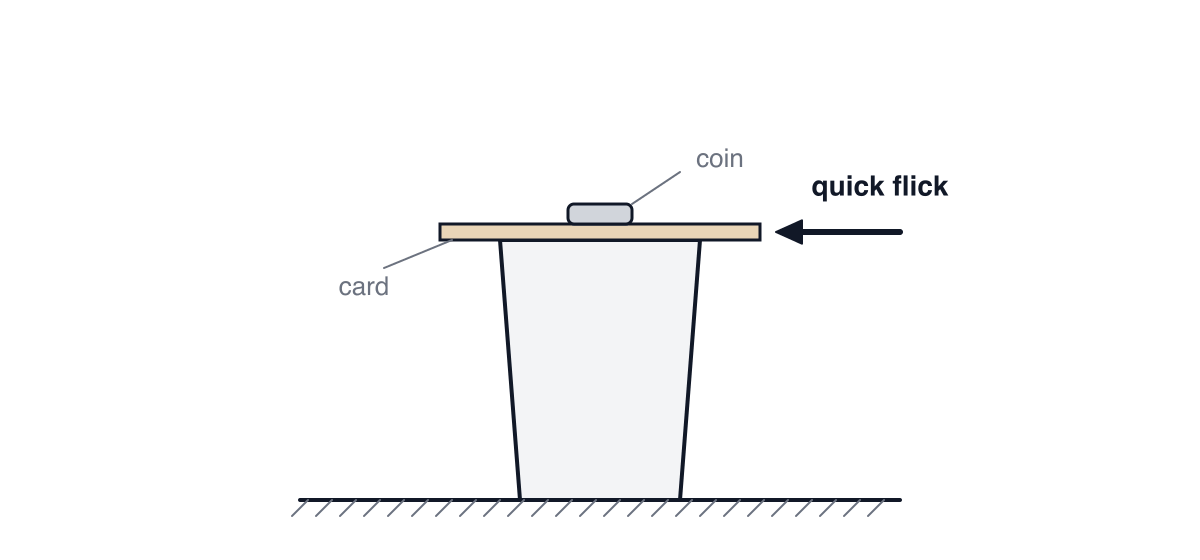
A coin rests on a card over a glass. The card is flicked away very quickly in the direction shown. What happens to the coin?
Show answer and working
Answer: C. It drops into the glass. The flick moves the card so fast that friction has almost no time to get the coin moving. The coin's inertia keeps it where it was, and once the card is gone it drops straight into the glass.
Question 31
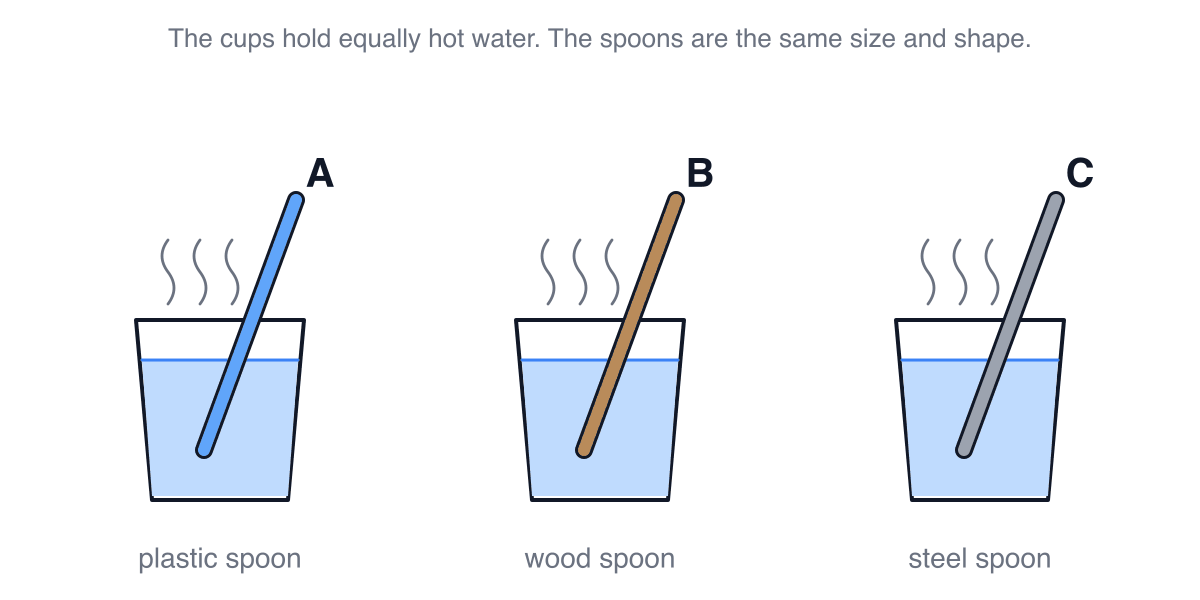
Which spoon's handle gets hot fastest?
Show answer and working
Answer: C. Spoon C. Metals are good conductors of heat, so heat travels up the steel spoon (spoon C) to its handle quickly. Wood and plastic are poor conductors, which is why pot handles and cooking spoons are often made of them.
Question 32
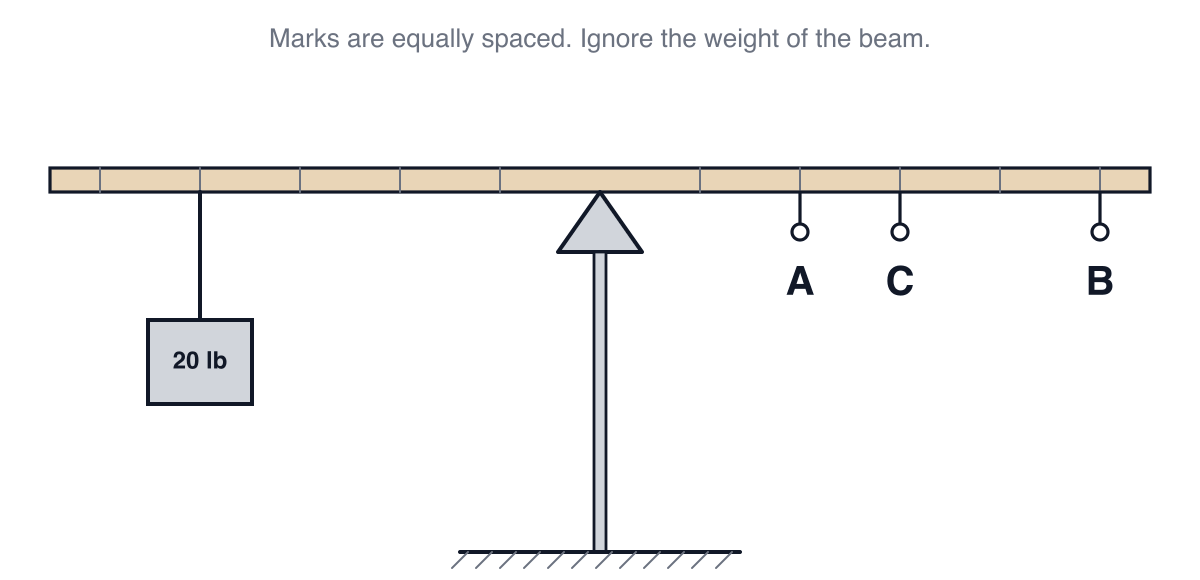
Where must a 40 lb weight be hung so that the beam balances?
Show answer and working
Answer: A. At A. The beam balances when weight times distance from the pivot is the same on both sides. The 20 lb weight hangs 4 marks out: 20 x 4 = 80. The 40 lb weight must therefore hang 80 / 40 = 2 marks out, which is point A.
Question 33
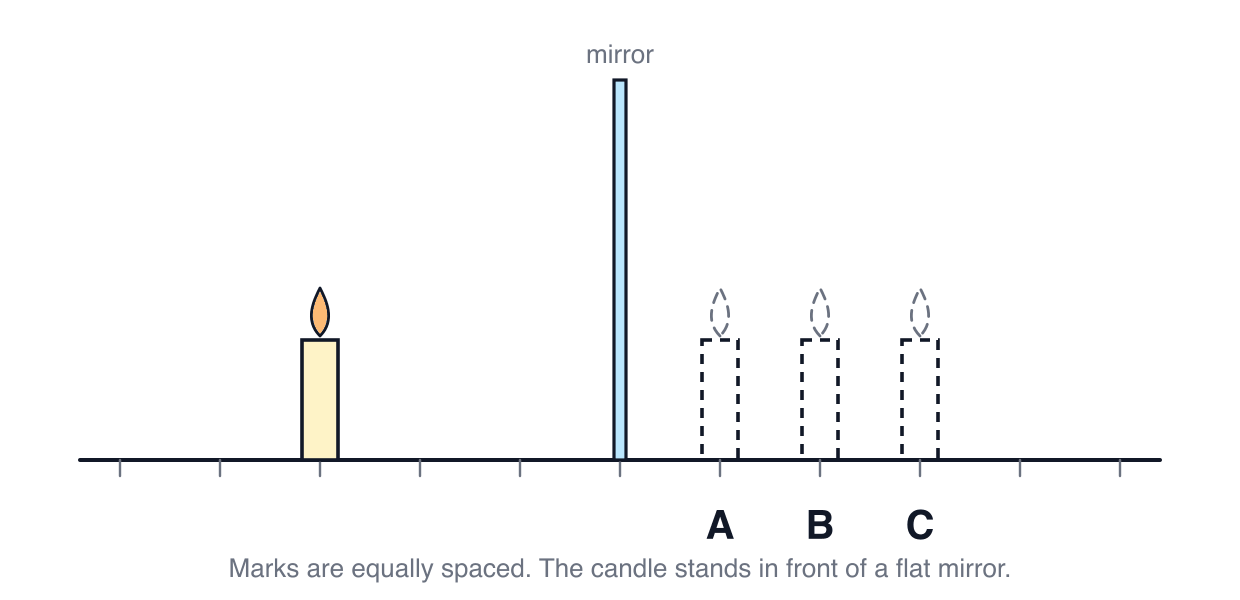
Where does the image of the candle appear to be?
Show answer and working
Answer: C. Position C. A flat mirror forms an image that appears as far behind the mirror as the object is in front of it. The candle is 3 marks in front of the mirror, so its image appears 3 marks behind it: position C.
Question 34
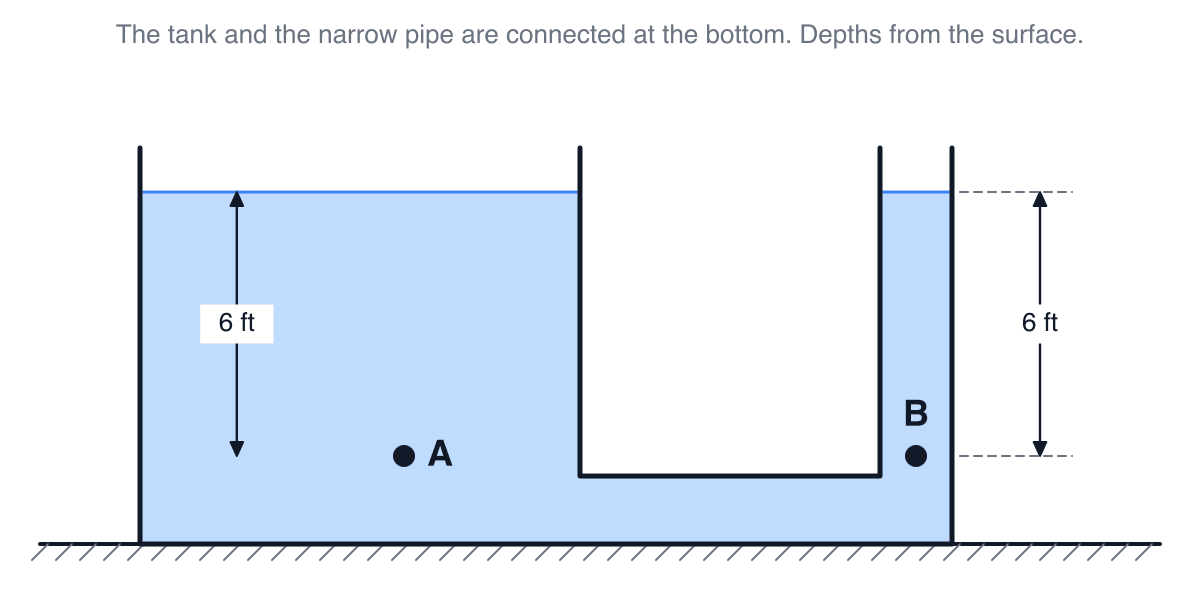
At which point is the water pressure greater?
Show answer and working
Answer: C. The same at both points. Water pressure depends only on how deep the point is below the surface. Both points are 6 ft deep, so the pressure is the same. The width of the tank or pipe and the amount of water beside the point make no difference.
Question 35
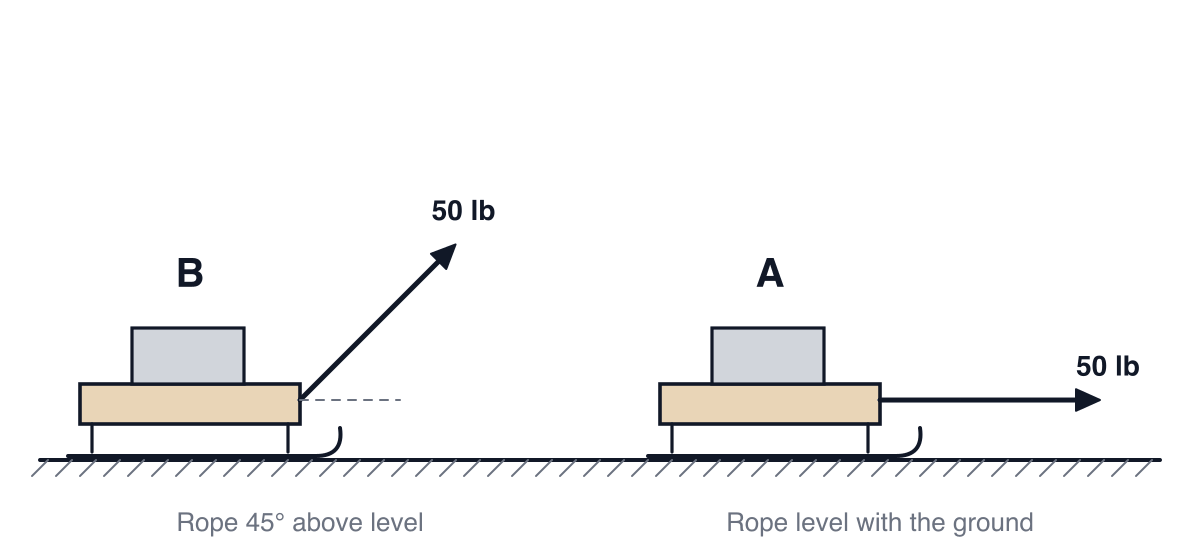
Both ropes pull with the same force. Which sled gets the greater forward pull along the ground?
Show answer and working
Answer: A. Sled A. Only the part of a pull that points along the ground moves the sled forward; the rest lifts. For sled A, a level 50 lb pull gives all 50 lb forward; for sled B, a 50 lb pull at 45° gives about 35 lb forward. The rope closer to level, on sled A, gives more forward pull.
Question 36
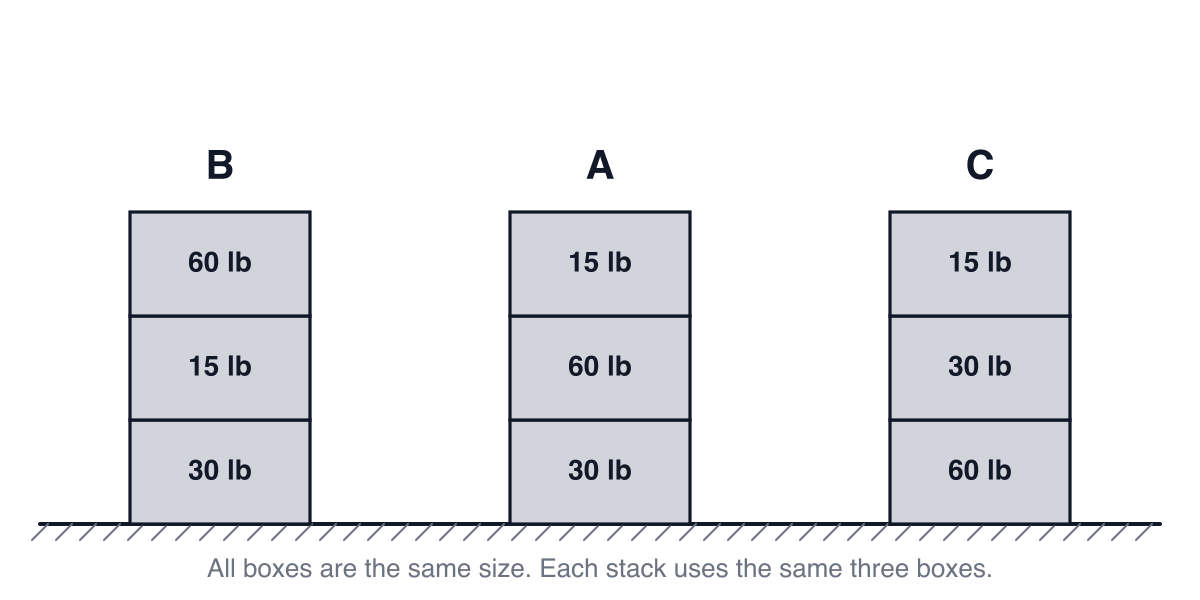
Which stack is least likely to tip over?
Show answer and working
Answer: C. Stack C. The lower a stack's center of gravity, the harder it is to tip, so the heaviest box belongs at the bottom. Measured in box heights from the floor, the centers of gravity are A 1.36, B 1.79 and C 1.07, so stack C is least likely to tip.
Question 37
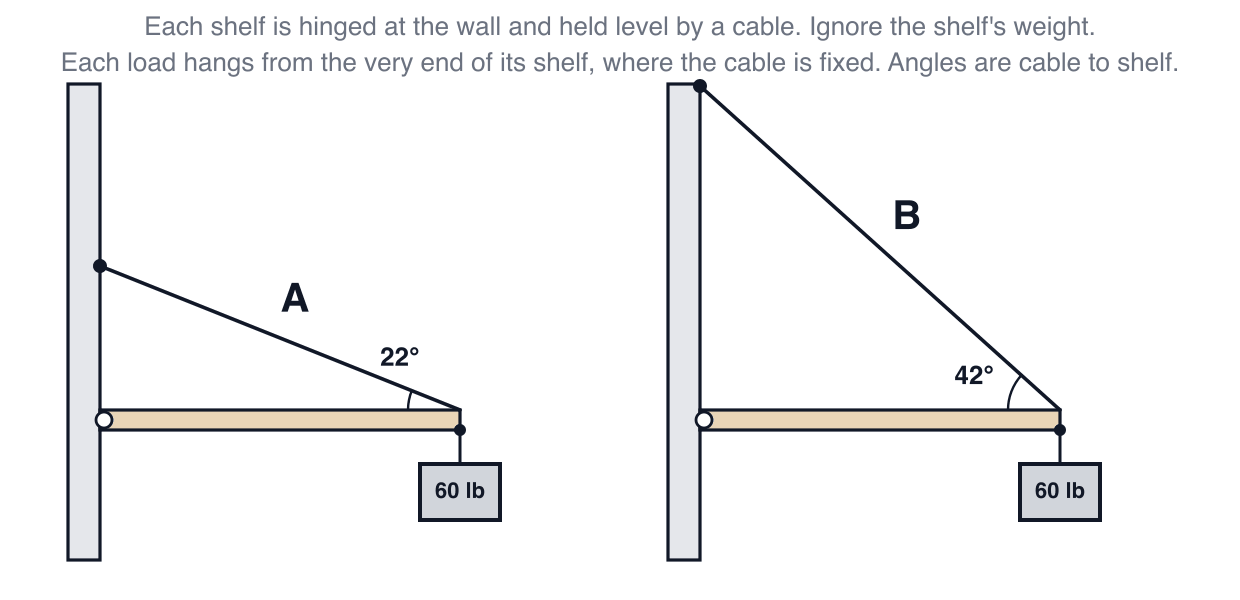
Which cable is under more tension?
Show answer and working
Answer: A. Cable A. Only the upward part of a cable's pull holds the load, so a shallow cable must pull harder to give the same lift. Cable A runs at 22 degrees to the shelf against 42 degrees for cable B, so it carries about 162 lb against 90 lb.
Question 38
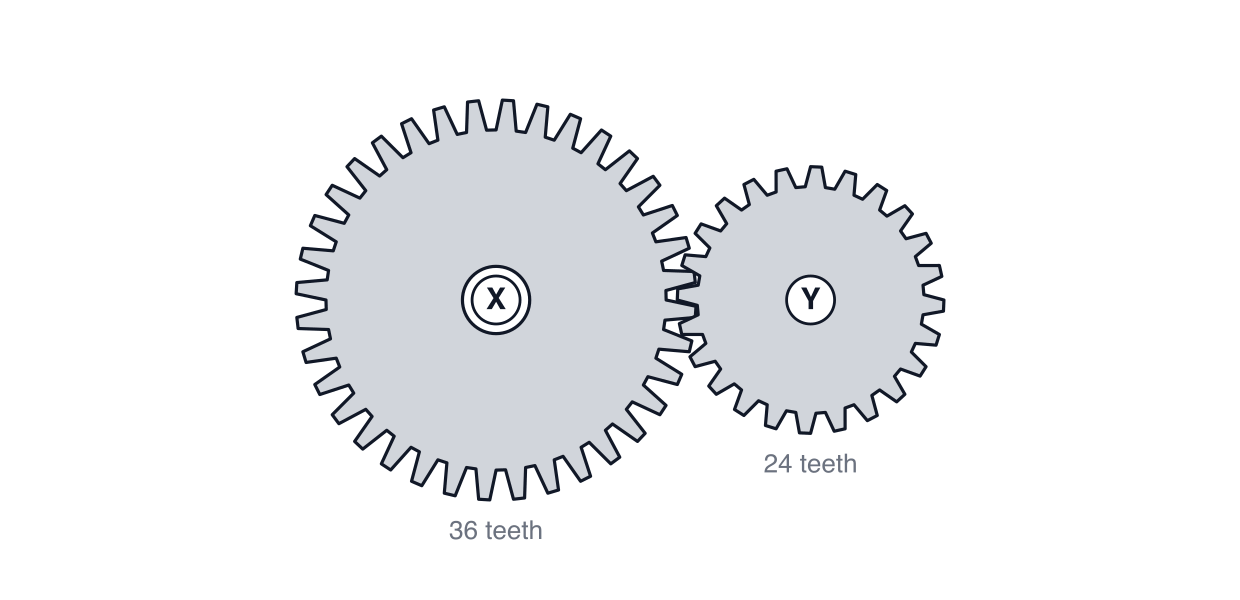
Gear X makes 6 turns. How many turns does gear Y make?
Show answer and working
Answer: A. 9 turns. Each turn of gear X moves 36 teeth past the mesh, so 6 turns move 216 teeth. Gear Y has 24 teeth, so it makes 216 / 24 = 9 turns.
Question 39
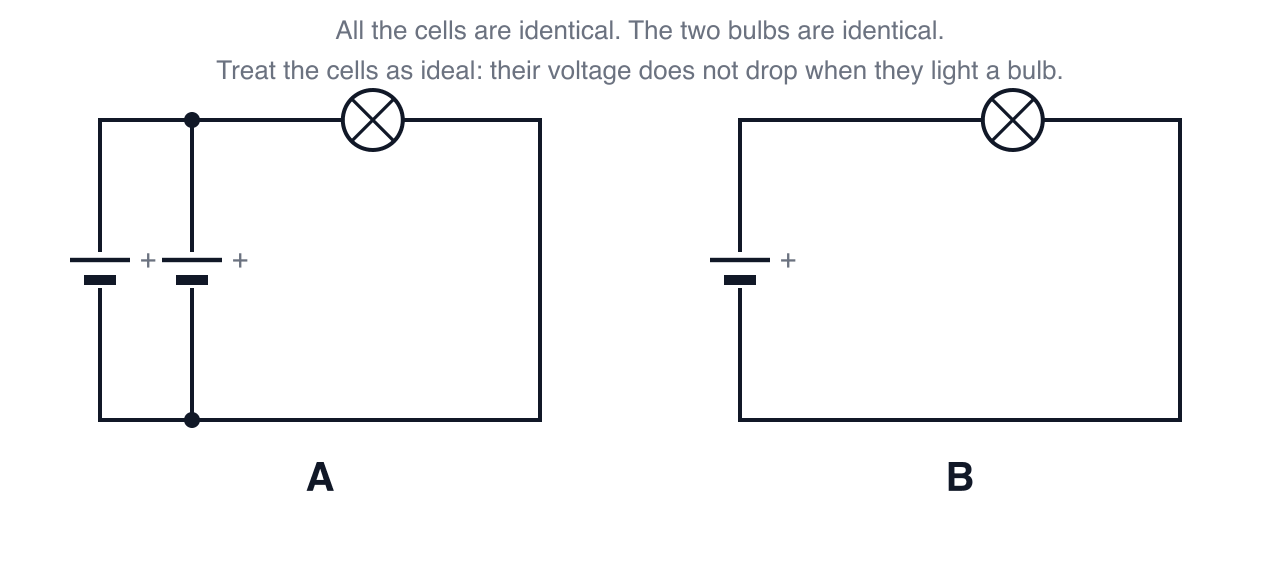
Which bulb glows more brightly?
Show answer and working
Answer: C. Both the same. In circuit A two cells side by side in parallel give the same voltage as one cell; they only last longer. In circuit B one cell gives the bulb the voltage of one cell. Both bulbs get the voltage of one cell, so they glow equally brightly.
Question 40
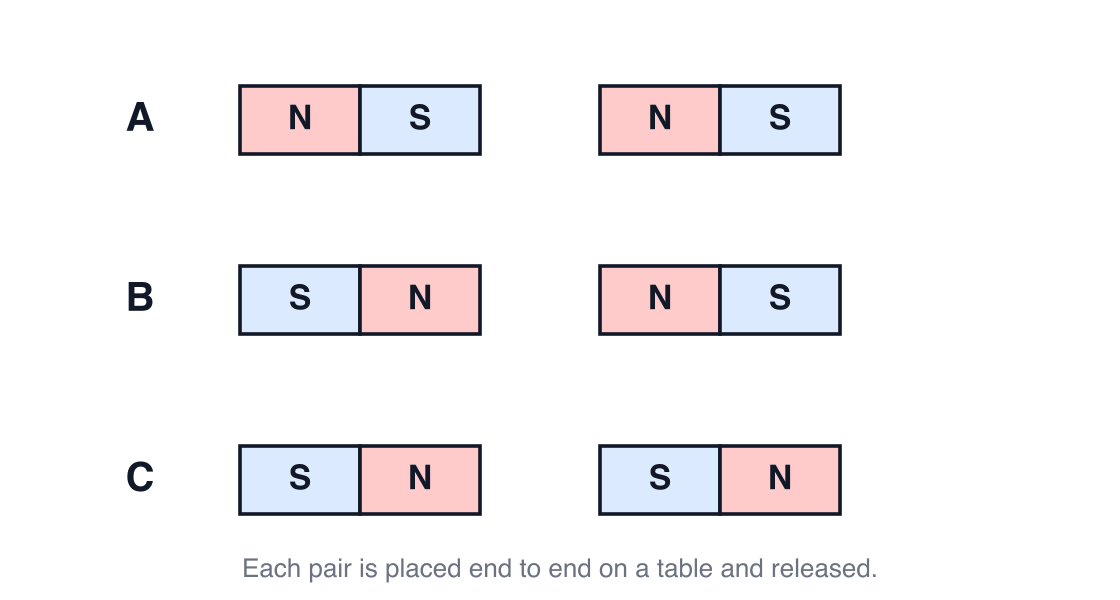
Which pair of magnets will push apart?
Show answer and working
Answer: B. Pair B. Like poles repel and unlike poles attract. In pair B the two facing ends are both N poles, so the magnets push apart. In the other two pairs a north pole faces a south pole, so those magnets pull together.
Question 41
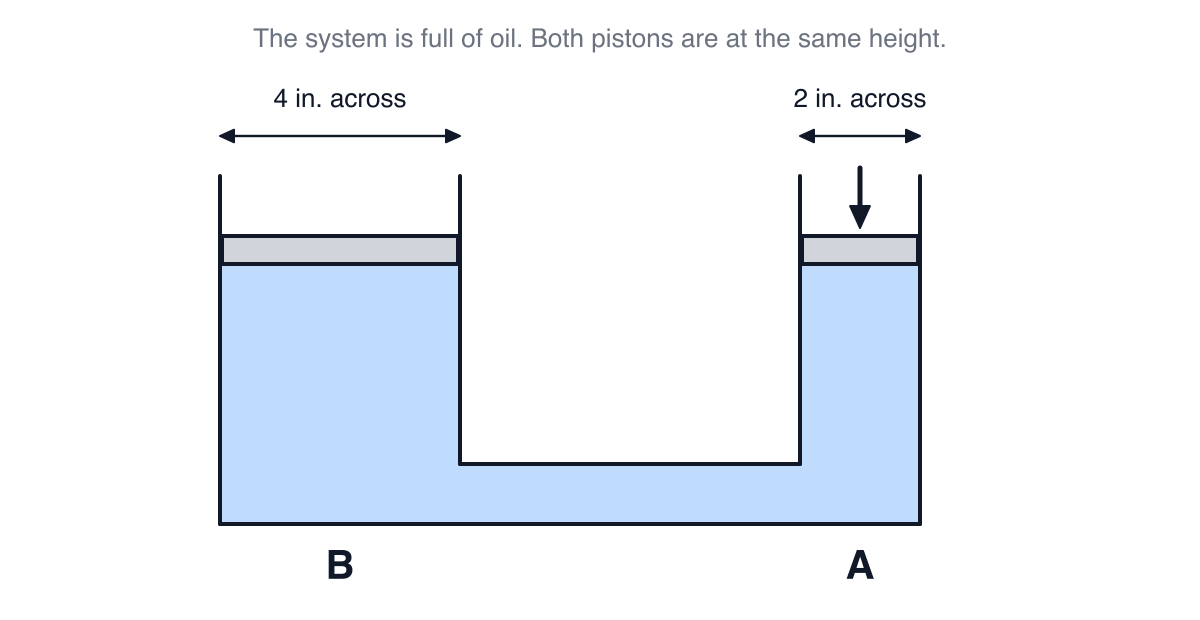
Piston A is pushed down, which forces piston B up. Which piston moves the greater distance?
Show answer and working
Answer: A. Piston A. The oil pushed out of one cylinder fills the other, so both pistons sweep the same volume. The narrower piston A (2 in. across) has 4 times less area, so it must move 4 times farther. Which piston is pushed does not matter.
Question 42
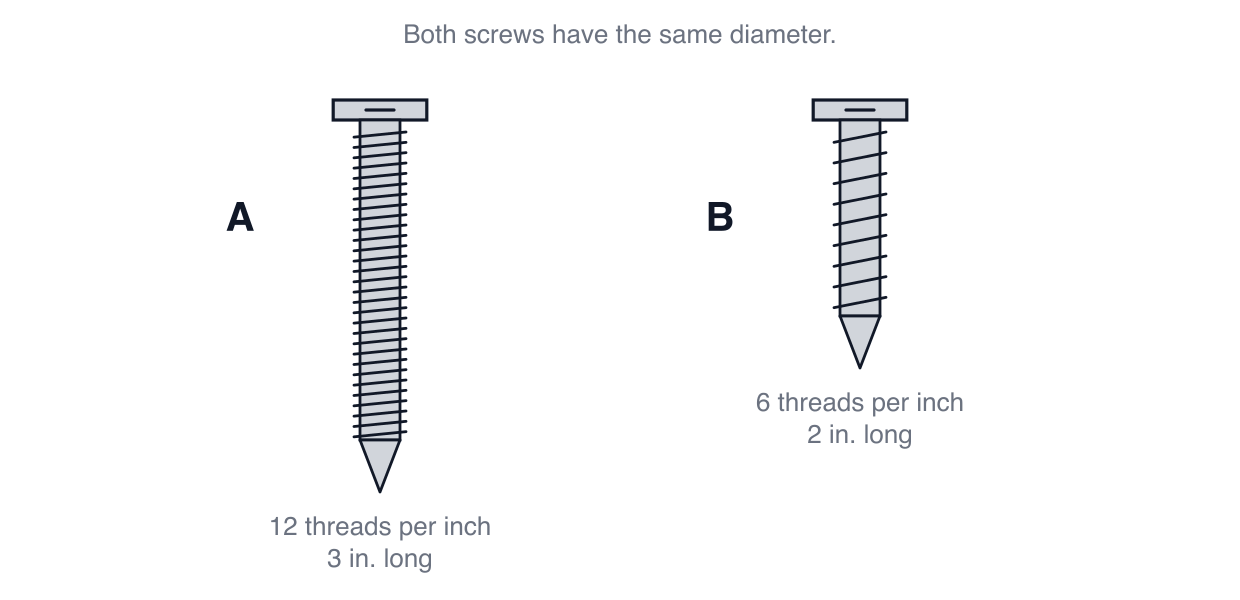
Which screw needs more turns to go 1 inch into the wood?
Show answer and working
Answer: A. Screw A. One full turn moves a screw forward by the spacing of its threads, so going 1 inch takes as many turns as there are threads per inch. Screw A needs 12 turns and screw B needs 6, so screw A needs more.
Question 43
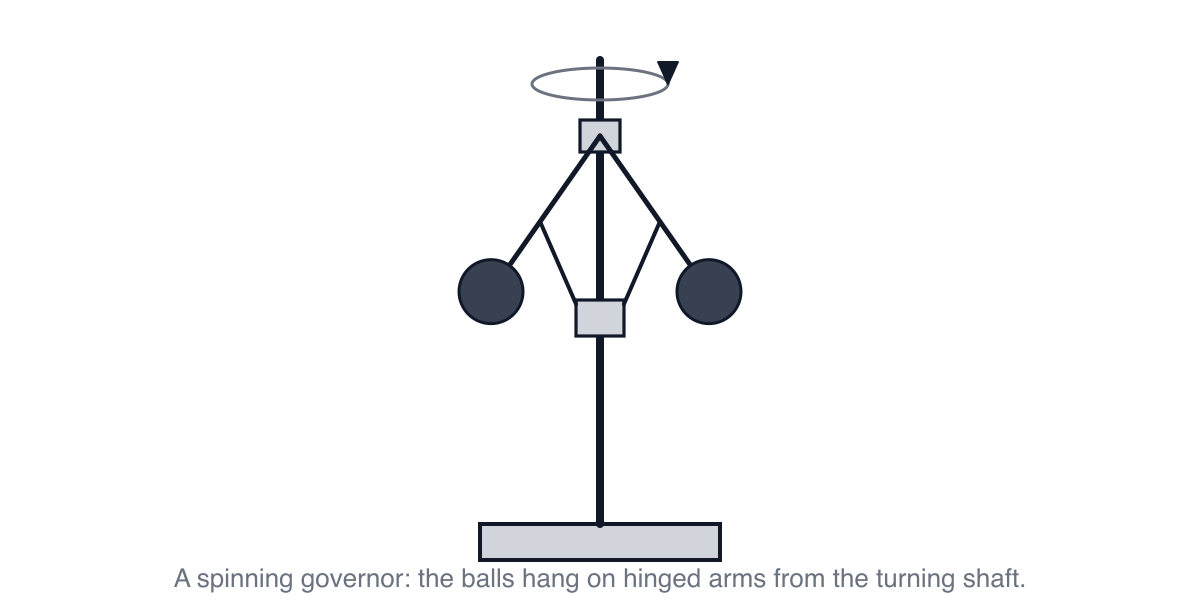
The shaft of the governor starts to spin faster. What happens to the two balls?
Show answer and working
Answer: B. They swing outward and upward. Holding each ball on its circle takes an inward pull, and spinning faster needs a bigger one. The hinged arms can only supply it by swinging out and up, so the balls fly outward. That is how a governor senses speed.
Question 44
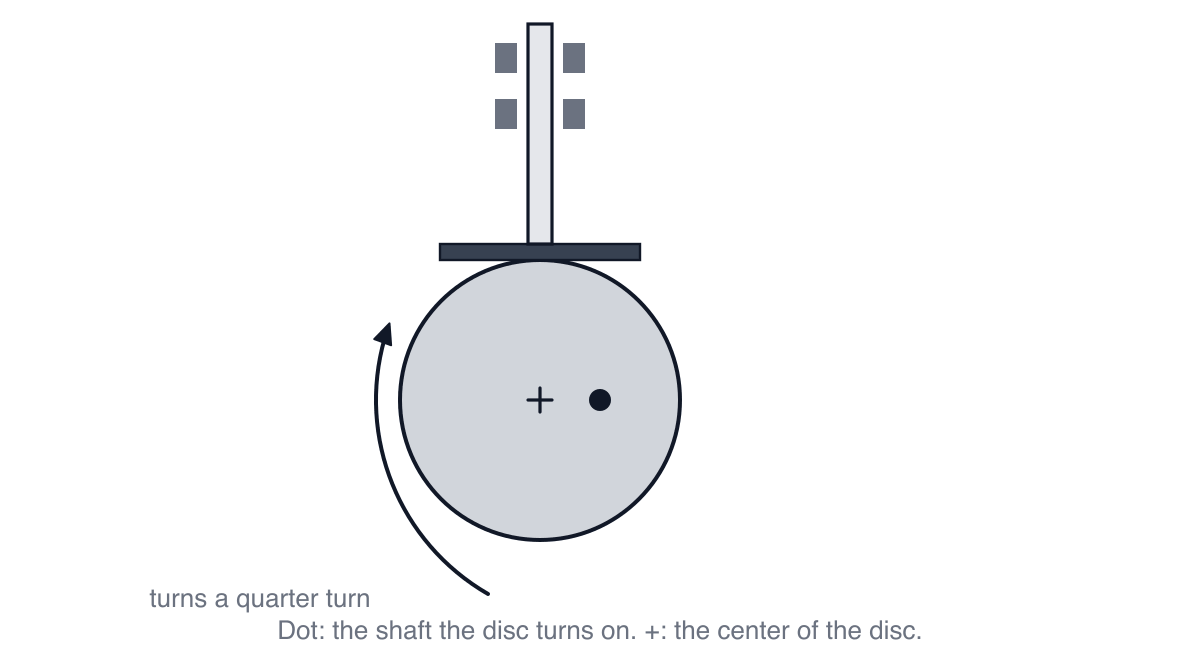
The disc turns on the shaft (dot), and the rod rests on top of it. After the disc turns exactly a quarter turn in the direction of the arrow, where will the rod be?
Show answer and working
Answer: A. Higher than now. The rod rests on the top of the disc, so it is higher when the disc's center is higher. The center is now to the left of the shaft; a quarter turn clockwise moves it so it is directly above the shaft, which is higher, so the rod rises.
Question 45
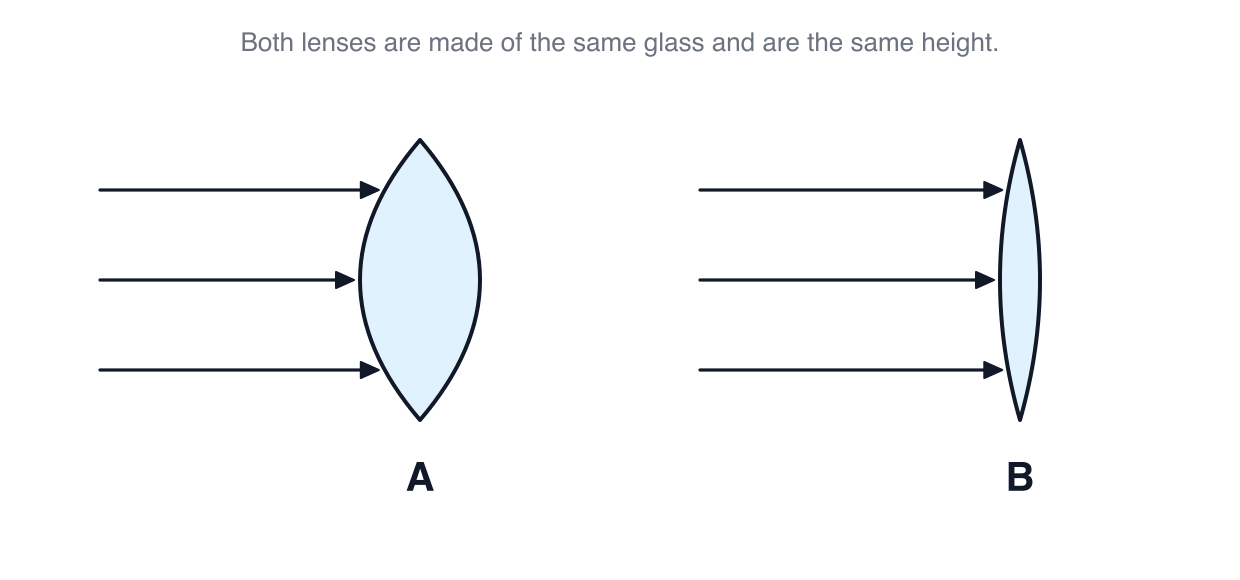
Parallel rays of light shine on two lenses. Which lens brings the light to a focus closer to itself?
Show answer and working
Answer: A. Lens A. The more strongly curved a convex lens is, the more sharply it bends light, so the rays meet closer to it: it has a shorter focal length. Lens A is the fatter, more curved lens.
Question 46
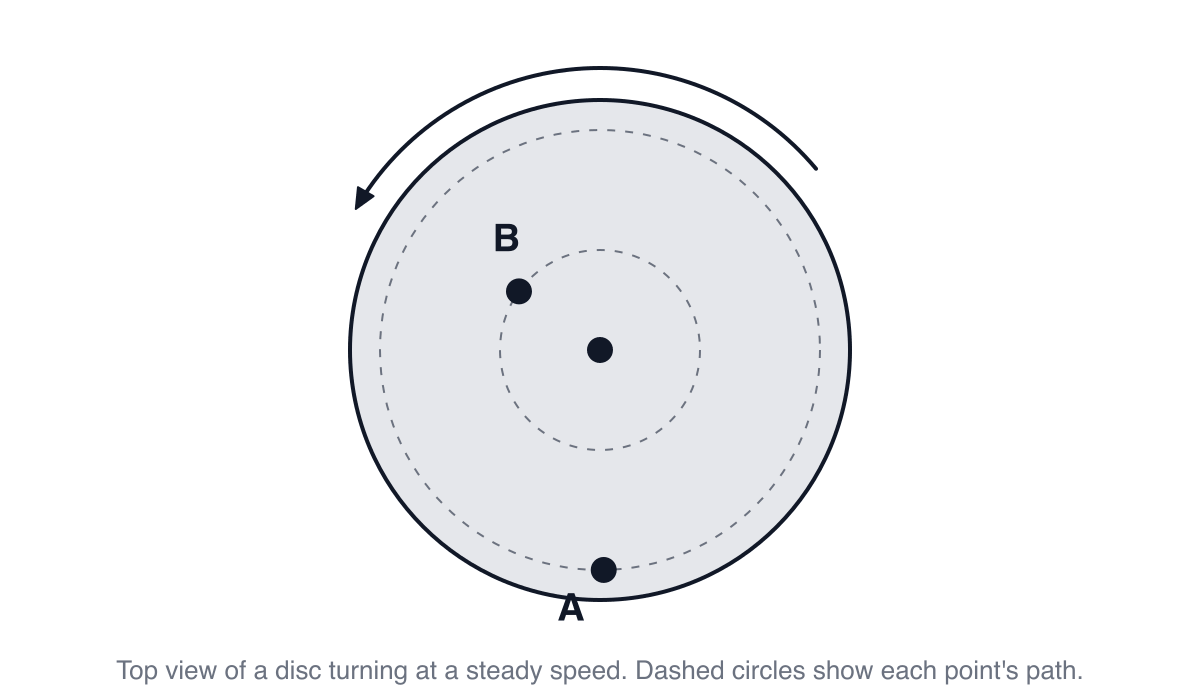
The disc turns at a steady speed. Which marked point is moving faster?
Show answer and working
Answer: A. Point A. Every point on the disc makes one turn in the same time, but a point farther from the center travels a bigger circle in that time. Point A is about 2.2 times as far from the center as the other, so it moves about that many times faster.
Question 47
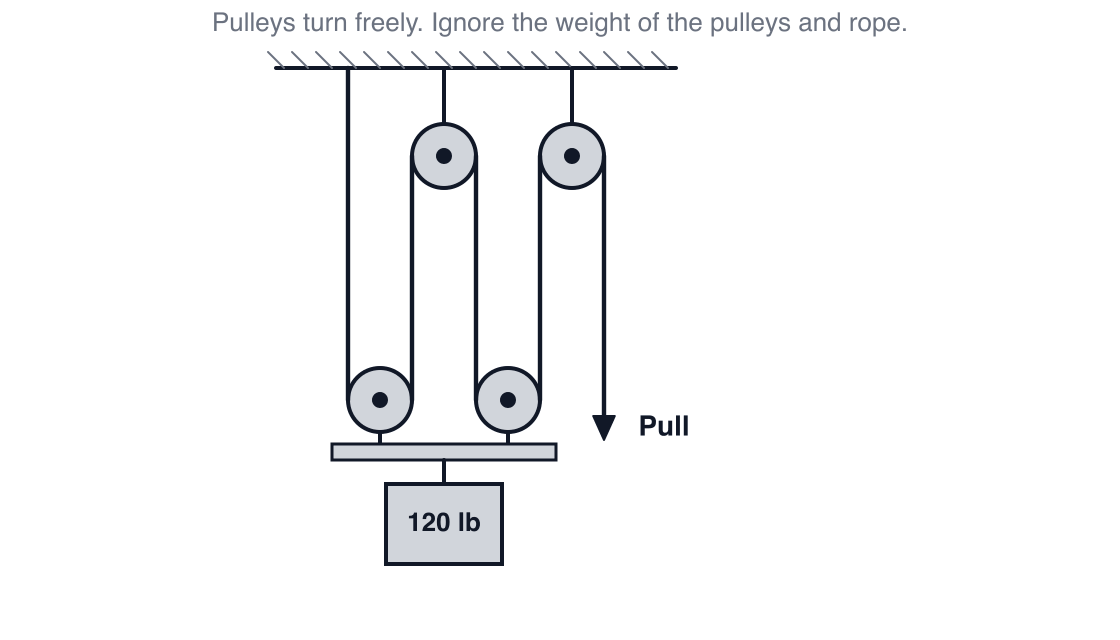
What pull is needed to hold the 120 lb weight still?
Show answer and working
Answer: B. 30 lb. 4 rope segments hold up the moving load. The pull end comes down off a fixed pulley, so it does not count. The weight is shared equally among them: 120 / 4 = 30 lb.
Question 48
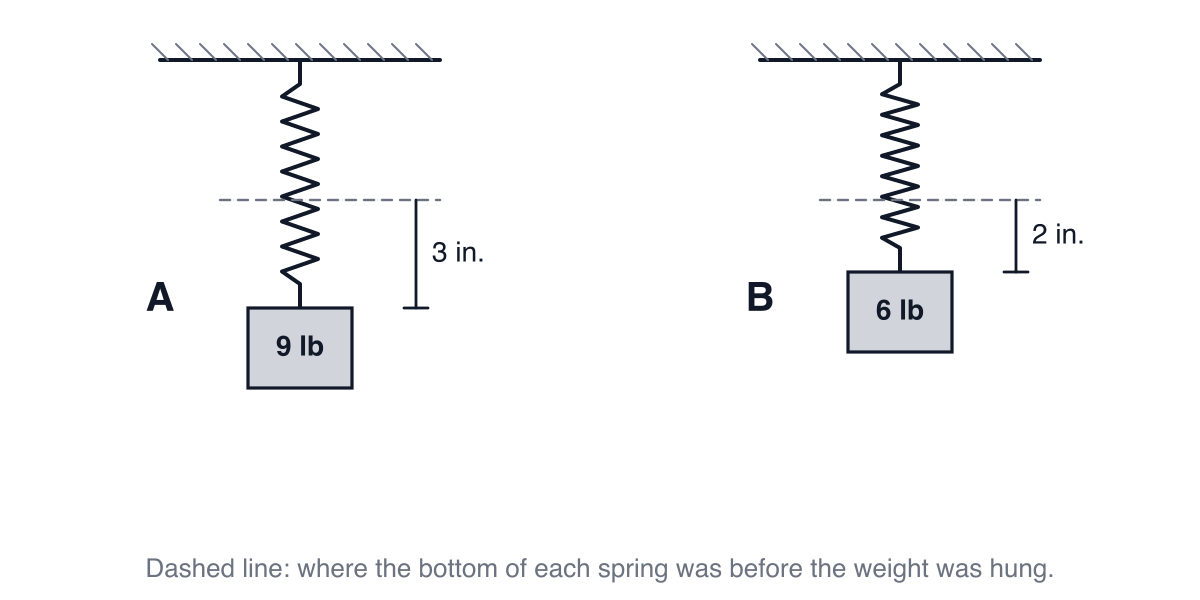
Each spring has stretched by the amount shown. Which spring is stiffer (needs more force to stretch it 1 inch)?
Show answer and working
Answer: C. Both are equally stiff. Stiffness is the force per inch of stretch. Spring A: 9 lb / 3 in. = 3 lb per inch; spring B: 6 lb / 2 in. = 3 lb per inch. The results are equal, so the springs are equally stiff even though they carry different weights.
Question 49
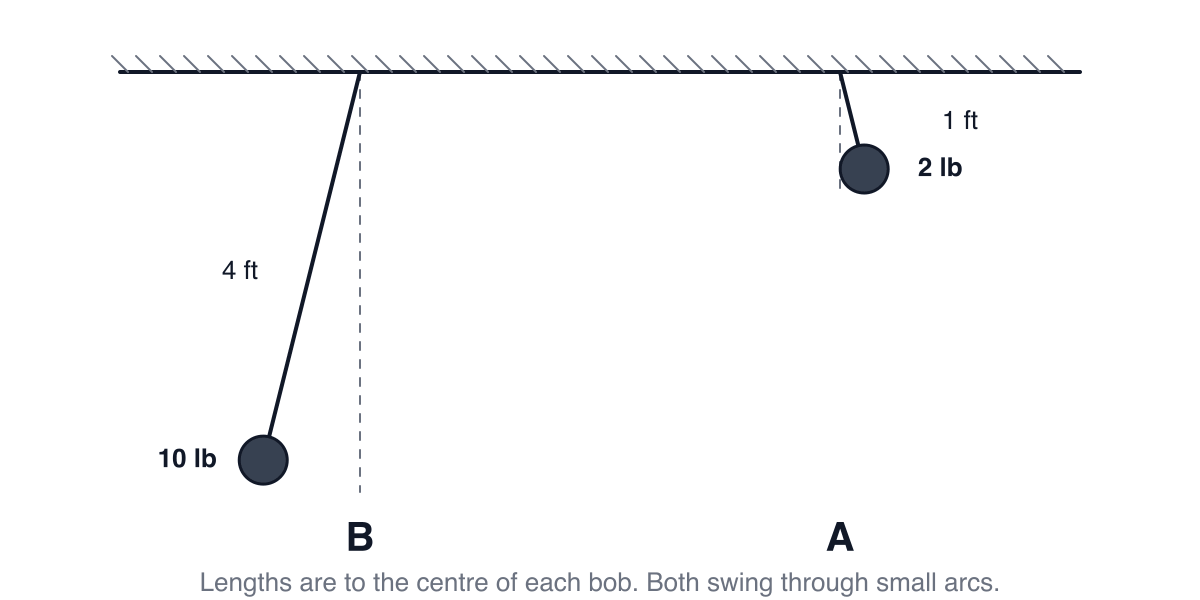
Which pendulum makes more complete swings each minute?
Show answer and working
Answer: A. Pendulum A. For small swings, a pendulum's timing depends only on its length: the shorter one swings faster, whatever the bob weighs. Pendulum A (1 ft) takes about 1.1 s per full swing and pendulum B (4 ft) about 2.2 s, so pendulum A makes more swings each minute.
Question 50
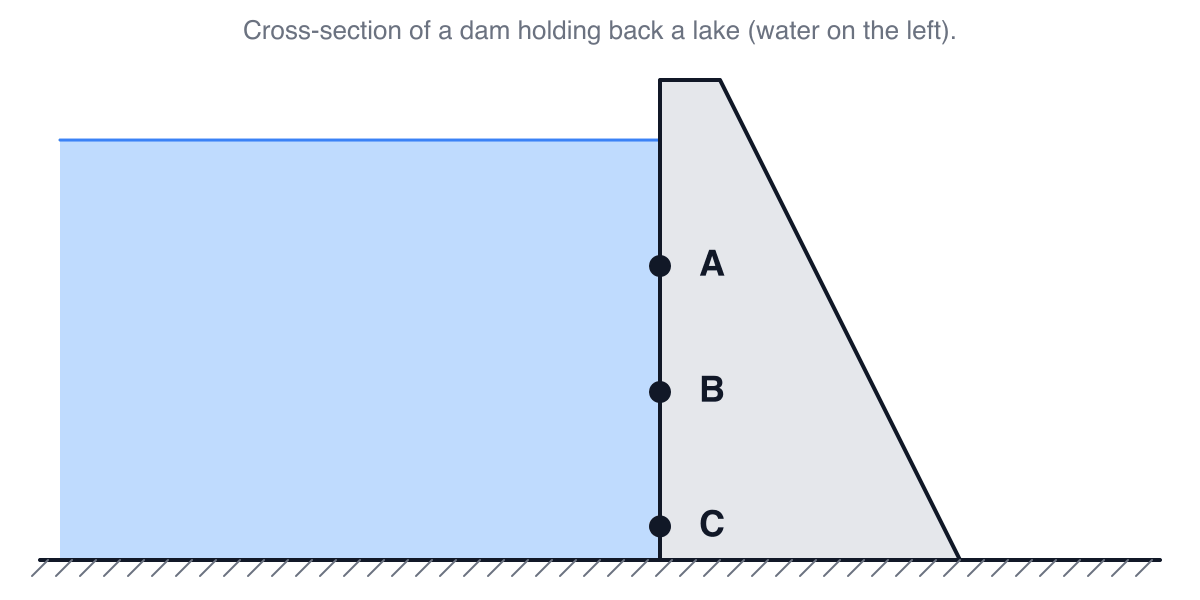
At which point does the water push hardest against the dam?
Show answer and working
Answer: C. Point C. Water pressure grows with depth below the surface, which is why dams are built thickest at the bottom. Point C is the deepest of the three, so the water pushes hardest there.
Question 51
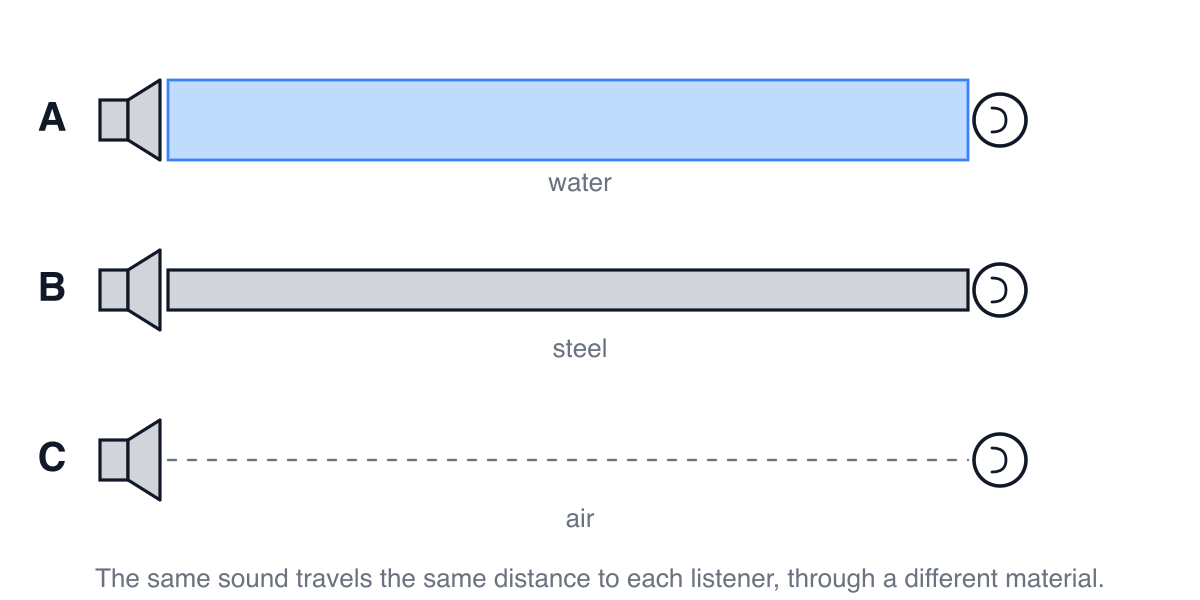
Through which material does the sound reach the listener last?
Show answer and working
Answer: C. Through C. Sound is a vibration passed from particle to particle, and it travels slowest through air, which is far easier to squeeze than water or steel. It moves at about 1,100 ft/s in air, about 4,900 ft/s in water and over 16,000 ft/s in steel, so the sound through air (path C) arrives last.
Question 52
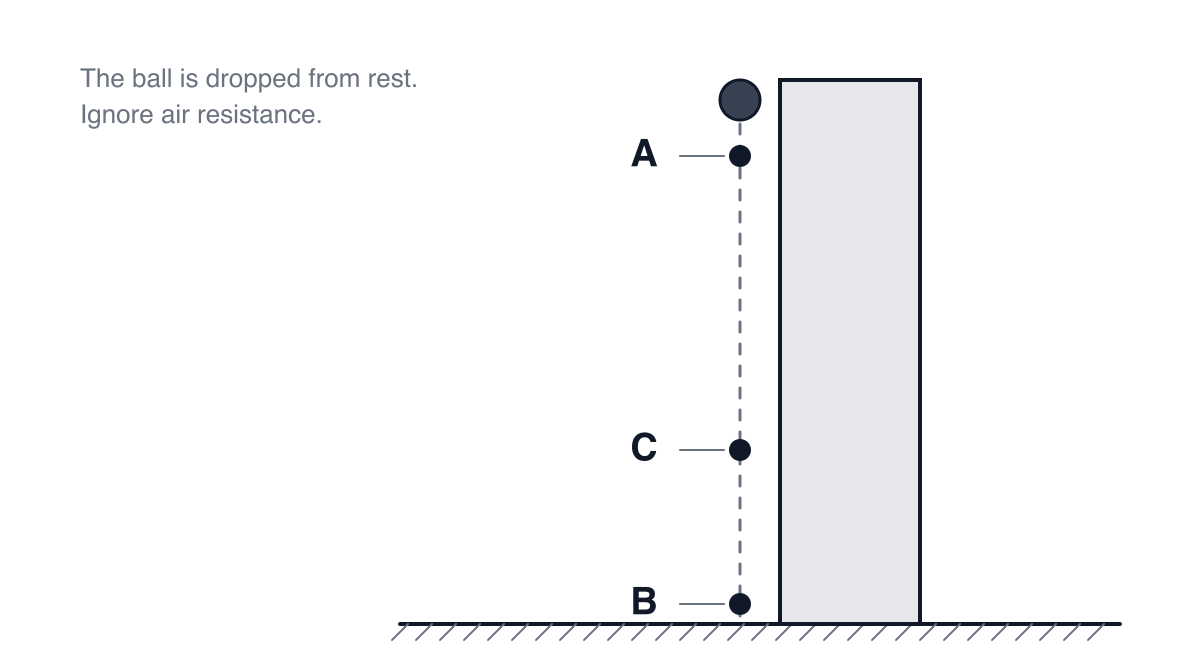
A ball is dropped from the top of the wall. At which marked point is it moving fastest?
Show answer and working
Answer: B. Point B. A falling ball keeps speeding up the whole way down, because gravity pulls on it the whole time. So it moves fastest at the lowest marked point, B: about 48 ft/s after falling 36 ft, against 16 ft/s after 4 ft.
Question 53
Which push turns the tight nut most easily?
Show answer and working
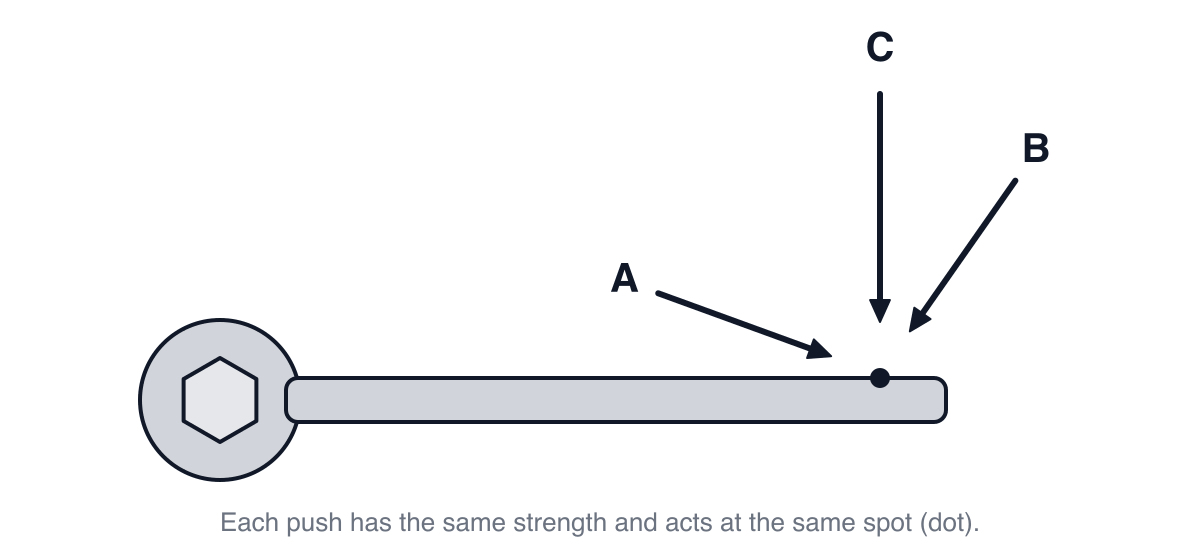
Answer: C. Push C. Only the part of a push that is at right angles to the handle turns the nut; the part along the handle just pulls or presses on the nut. Push C is square to the handle, so all of it turns the nut.
Question 54
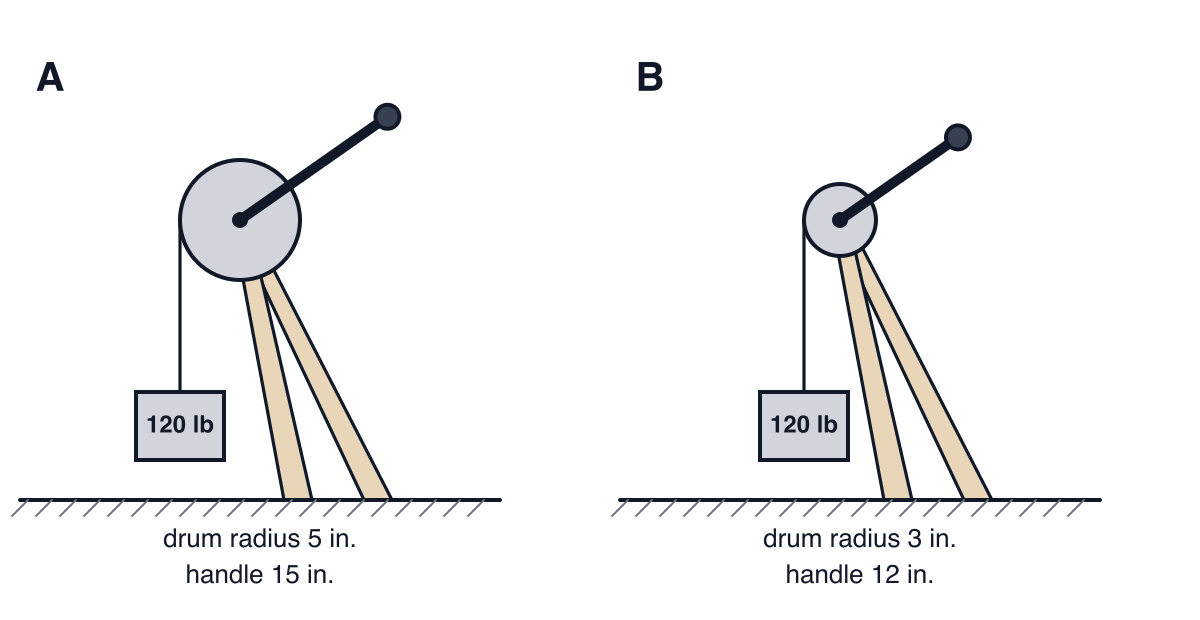
Each winch holds the same load. Which winch needs less force on the handle to lift it?
Show answer and working
Answer: B. Winch B. The handle force times the handle length must match the load times the drum radius. Winch A: 120 x 5 / 15 = 40 lb. Winch B: 120 x 3 / 12 = 30 lb. Winch B needs less force.
Question 55
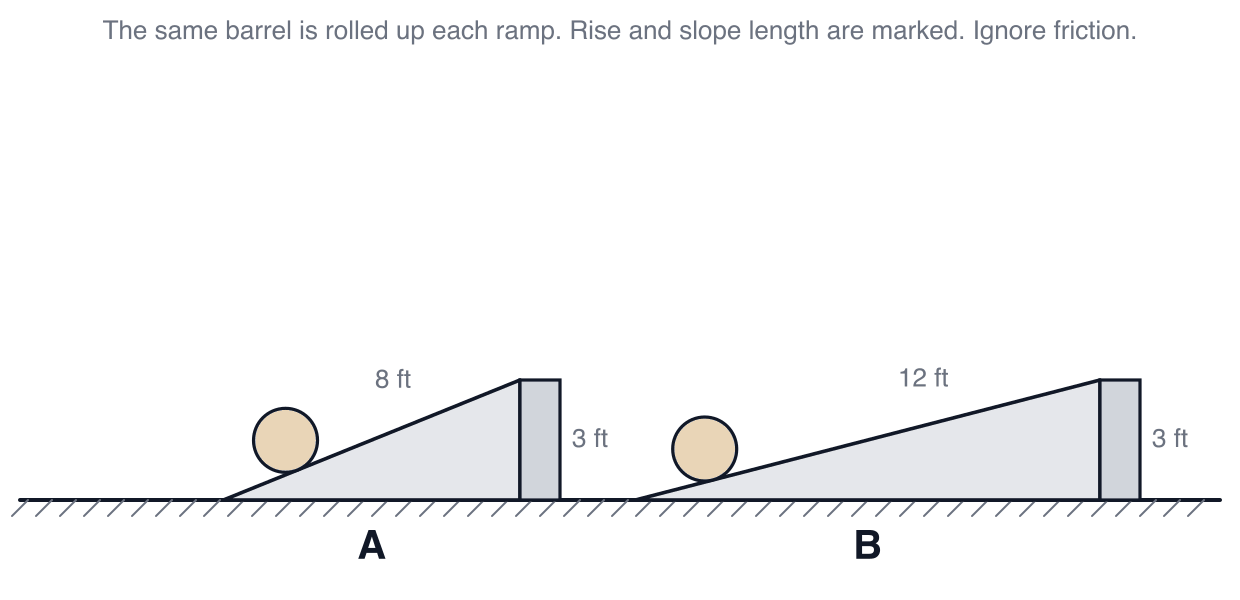
Which ramp needs the smaller push to roll the barrel up?
Show answer and working
Answer: B. Ramp B. On a slope the push needed is the weight times rise over slope length. Ramp B gives 3/12 of the weight and ramp A gives 3/8, so ramp B, the gentler slope, needs the smaller push.
Ramsay-style test: 36 questions, 20 minutes
Built to the Ramsay MAT-4 format: 36 multiple-choice questions mixing tools, household objects, workplace machines and school physics, 16 of them with diagrams.
Question 1
A rectangular block is placed on a surface that is gradually tilted. The surface has been tilted far enough that the center of mass has passed outside the base. What happens to the block?
Show answer and working
Answer: D. The block tips over.. A block tips when its center of mass passes outside the base of support. Here the block tips over.
Question 2
A bicycle is easier to pedal uphill in a lower gear because lower gears:
Show answer and working
Answer: A. reduce the force required at the cost of more pedaling. A low gear has a smaller mechanical advantage for speed but a larger one for force, reducing effort per pedal.
Question 3
Heat transfer through a solid metal rod is primarily by:
Show answer and working
Answer: C. conduction. In solids, heat transfers by conduction via molecular and electron vibration.
Question 4
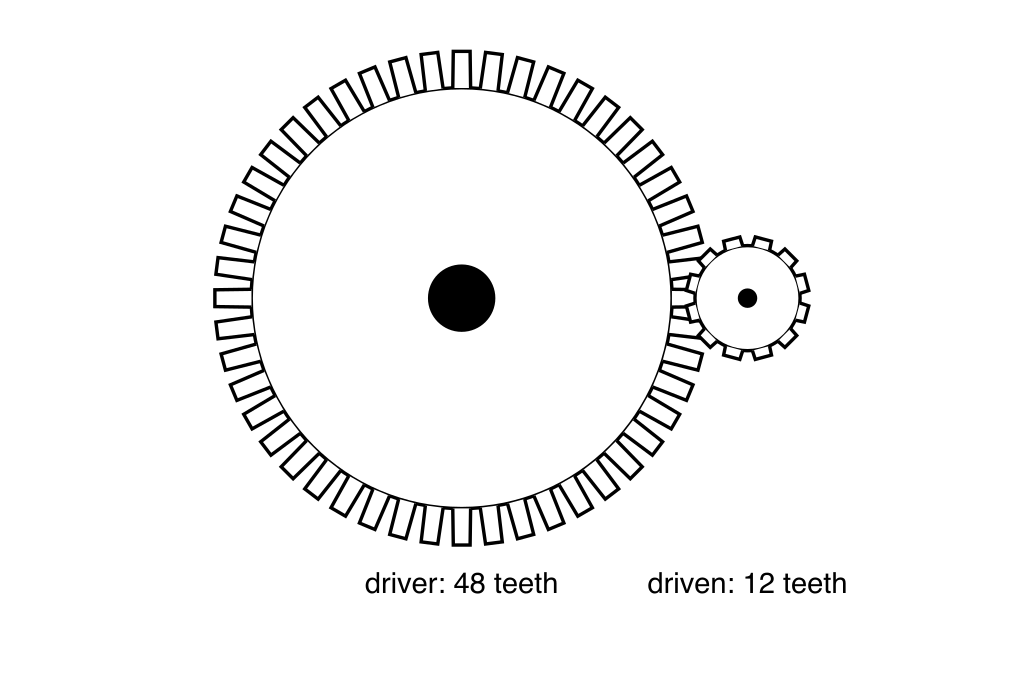
Two meshed gears are shown. The driver gear has 48 teeth and the driven gear has 12 teeth. What effect does this have compared to connecting them 1 to 1?
Show answer and working
Answer: C. decreases torque and increases speed. When a smaller driver meshes with a larger driven gear, torque increases and speed decreases in the ratio 48/12. When a larger driver meshes with a smaller driven gear, the reverse happens.
Question 5
Which of these is the best conductor of electricity?
Show answer and working
Answer: D. copper. Copper is a metal with a high density of free electrons, making it an excellent conductor.
Question 6
Which tool is most appropriate to drive a Phillips-head screw?
Show answer and working
Answer: E. Phillips screwdriver. A Phillips screwdriver is the standard tool for this task.
Question 7
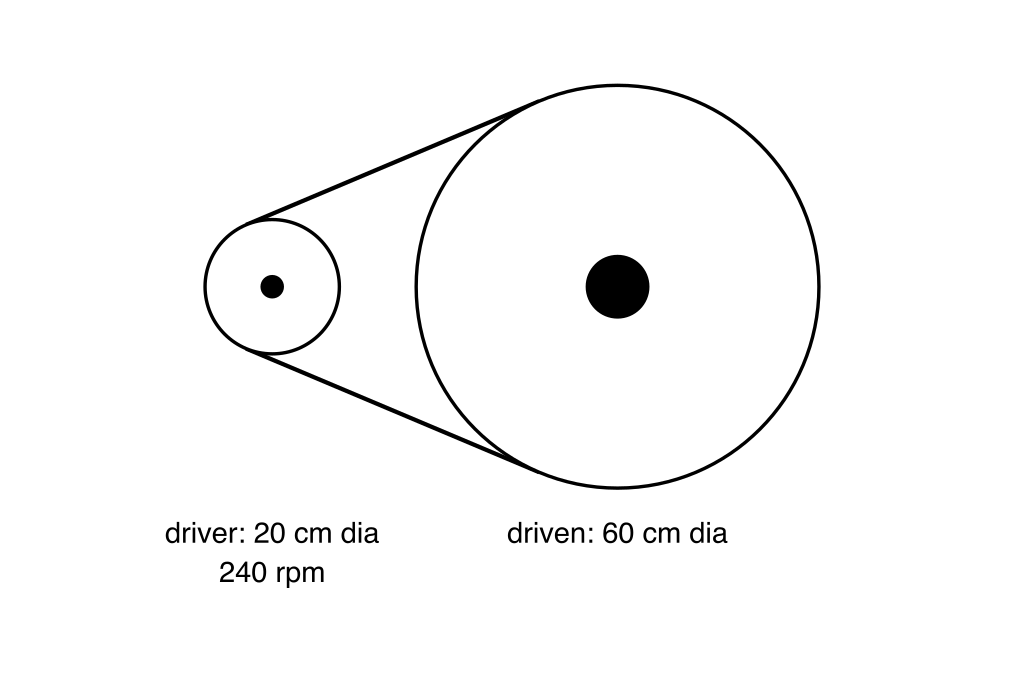
Two pulleys are connected by a belt. The driver pulley has a diameter of 20 cm and turns at 240 rpm. The driven pulley has a diameter of 60 cm. At what speed does the driven pulley turn?
Show answer and working
Answer: D. 80 rpm. For belt drives, d1 * rpm1 = d2 * rpm2. So rpm2 = 20 * 240 / 60 = 80 rpm.
Question 8
A rectangular block is placed on a surface that is gradually tilted. The surface has been slightly tilted so the center of mass is still over the base. What happens to the block?
Show answer and working
Answer: E. The block remains stable.. A block tips when its center of mass passes outside the base of support. Here the block remains stable.
Question 9
Loosening a rusted nut is easier with a longer wrench because:
Show answer and working
Answer: B. a longer wrench produces more torque for the same applied force. Torque equals force times moment arm. A longer wrench increases the moment arm, so the same force creates more torque.
Question 10
A fuse in an electrical circuit is designed to:
Show answer and working
Answer: B. melt and break the circuit when current exceeds a safe level. A fuse is a sacrificial protection device that melts and opens the circuit to prevent overload damage.
Question 11
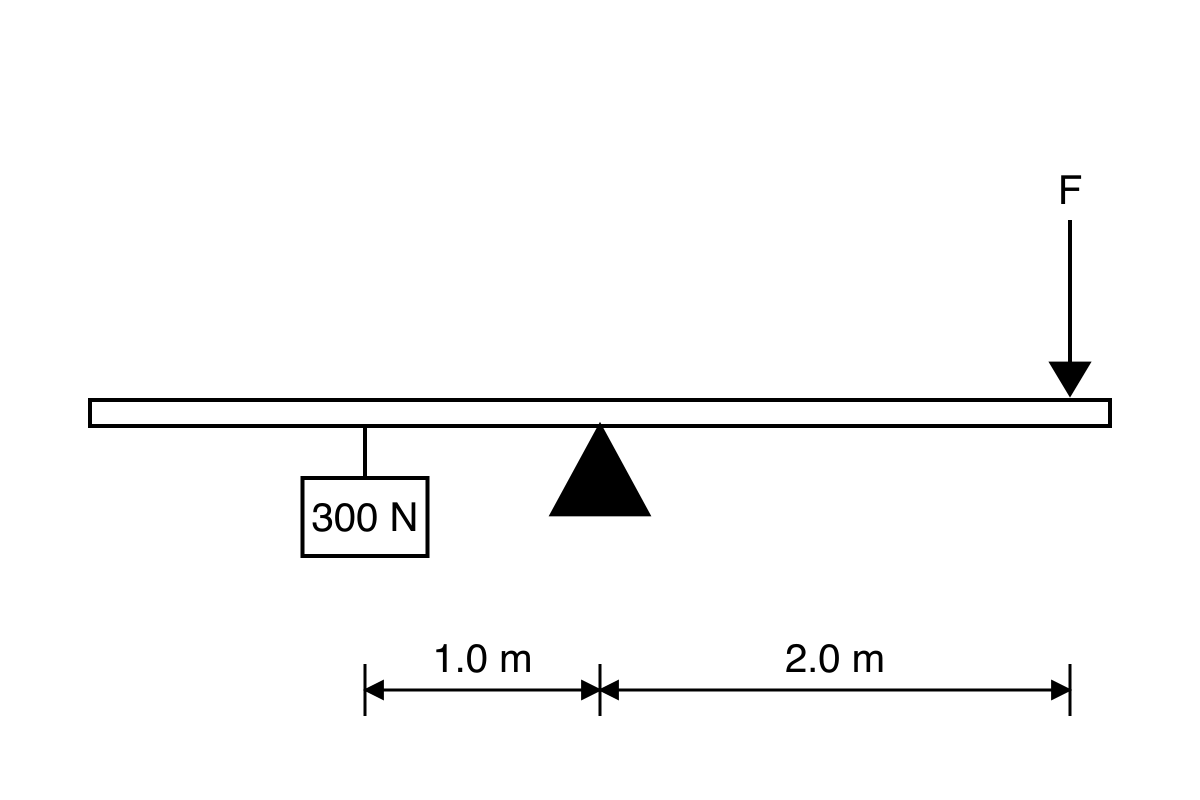
A first-class lever has its fulcrum in the middle. A load of 300 N sits 1.0 m from the fulcrum. The effort is applied 2.0 m from the fulcrum on the opposite side. Ignoring the lever mass, what effort lifts the load?
Show answer and working
Answer: C. 150 N. For a lever in balance, load * load_arm = effort * effort_arm. So effort = 300 * 1.0 / 2.0 = 150 N.
Question 12
The echo of a shout returns after 2 seconds. Sound travels at 340 m/s in air. How far is the reflecting surface?
Show answer and working
Answer: C. 340 m. The sound travels to the surface and back in 2 s, so one-way travel is 1 s. Distance = 340 m/s * 1 s = 340 m.
Question 13
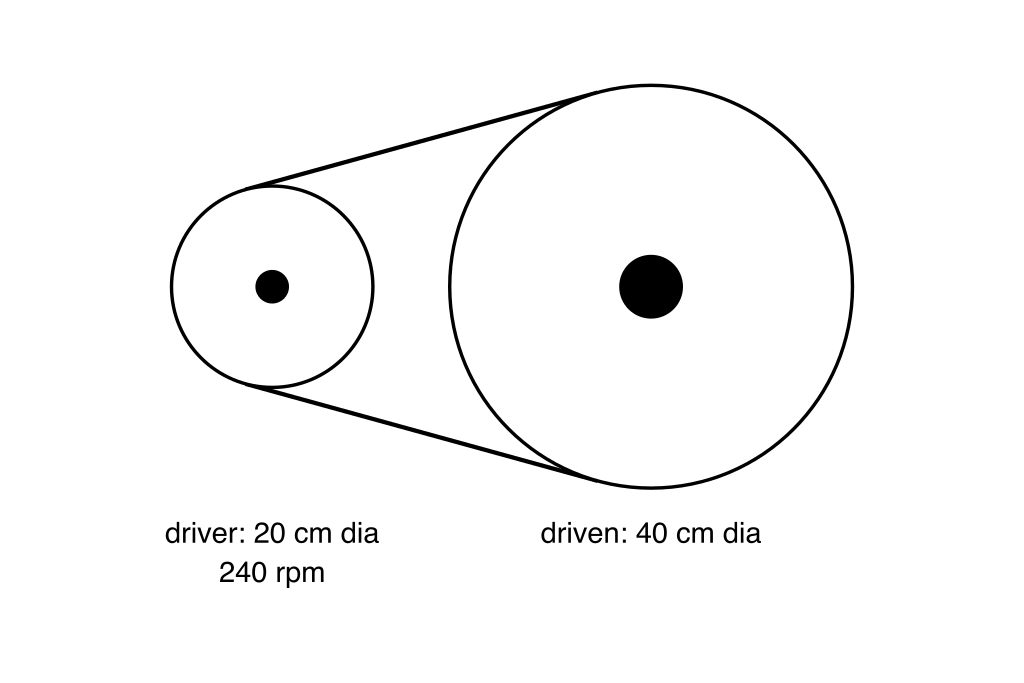
Two pulleys are connected by a belt. The driver pulley has a diameter of 20 cm and turns at 240 rpm. The driven pulley has a diameter of 40 cm. At what speed does the driven pulley turn?
Show answer and working
Answer: B. 120 rpm. For belt drives, d1 * rpm1 = d2 * rpm2. So rpm2 = 20 * 240 / 40 = 120 rpm.
Question 14
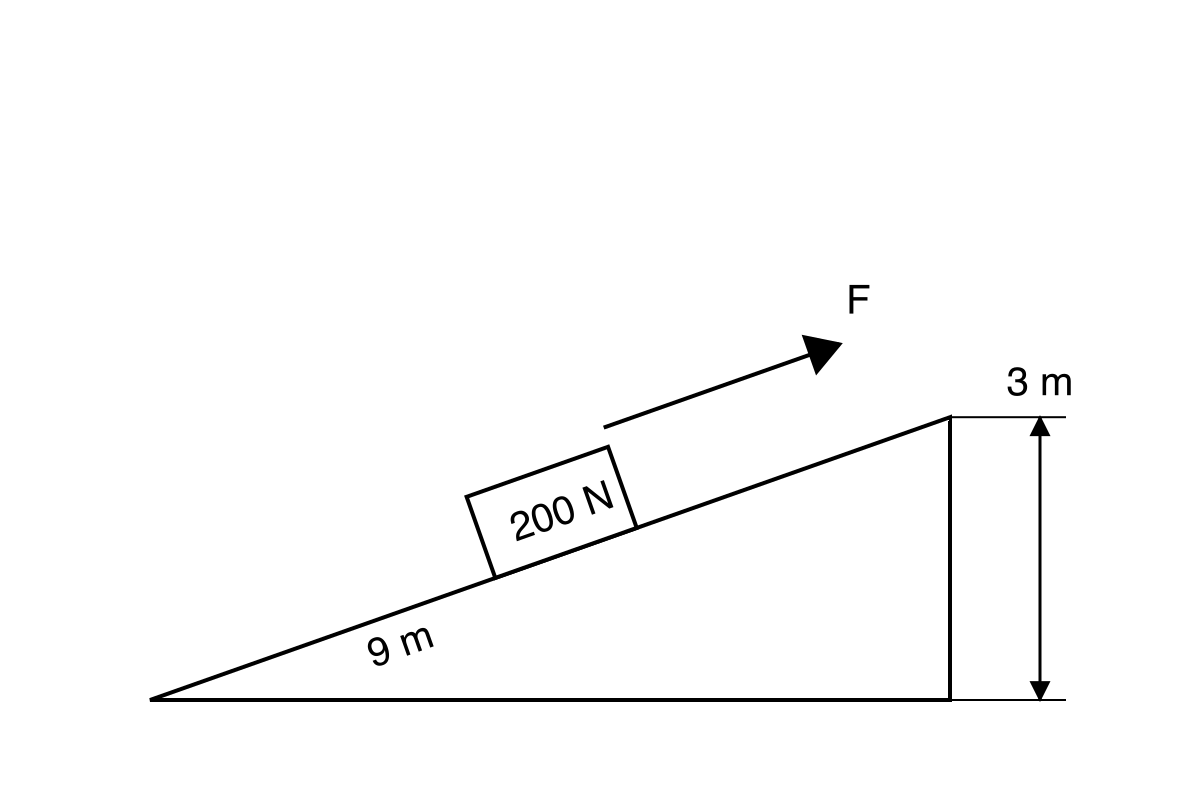
A frictionless inclined plane is 9 m long and 3 m high. A cart weighing 200 N is pushed up the ramp. What force is needed parallel to the ramp surface? Round to the nearest newton.
Show answer and working
Answer: D. 67 N. On a frictionless ramp the effort is load x height / length: 200 x 3 / 9 = 66.67 N, so 67 N to the nearest newton.
Question 15
Sound travels fastest through which medium?
Show answer and working
Answer: A. a solid like steel. Sound requires a medium with closely packed particles. Solids transmit sound fastest because particles are tightly bonded.
Question 16
Why does a car tire go flat slowly over days even without a visible puncture?
Show answer and working
Answer: C. air molecules gradually permeate through the rubber. Rubber is not perfectly airtight. Air molecules slowly diffuse through it over time.
Question 17
A convex lens is used in a magnifying glass because it:
Show answer and working
Answer: A. converges light rays and can form a magnified image. A convex lens converges light and can produce enlarged virtual images when the object is within the focal length.
Question 18
Which tool is most appropriate to smooth a rough wood surface?
Show answer and working
Answer: A. sandpaper. A sandpaper is the standard tool for this task.
Question 19
Which tool is most appropriate to cut a 2x4 wooden board?
Show answer and working
Answer: C. circular saw. A circular saw is the standard tool for this task.
Question 20
Two identical bulbs are connected in parallel to a battery. If one bulb burns out, the other bulb will:
Show answer and working
Answer: B. continue to glow at its normal brightness. In a parallel circuit each branch is independent, so breaking one branch does not interrupt current in the other.
Question 21
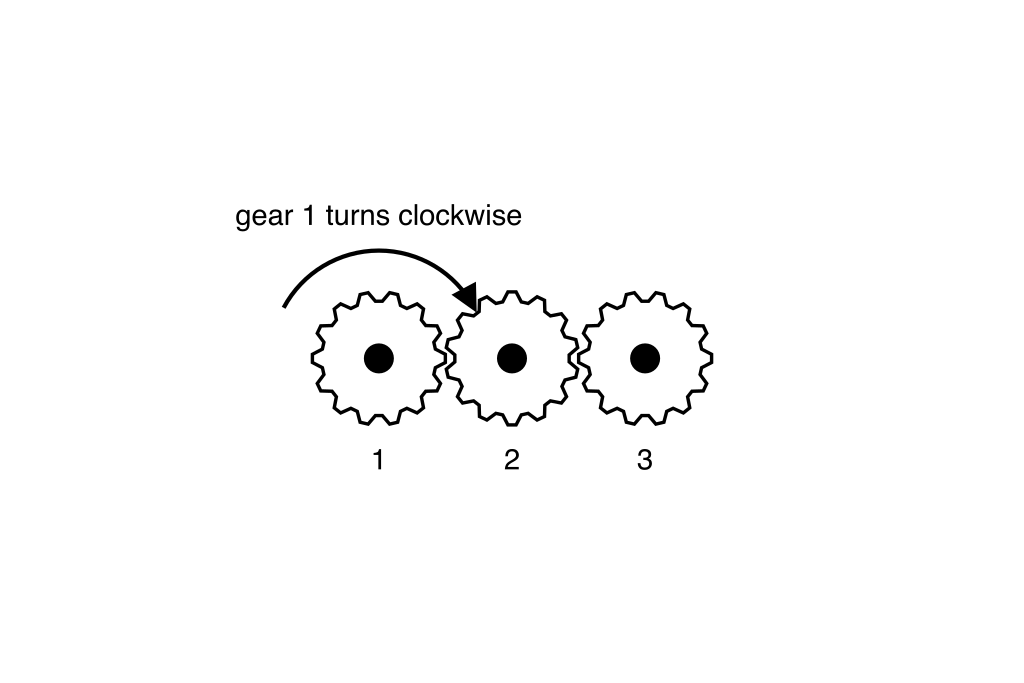
A chain of 3 meshed gears lies in a row. The first gear rotates clockwise. In what direction does the last gear rotate?
Show answer and working
Answer: C. clockwise. Each pair of meshed gears rotates in opposite directions. The last gear (position 3 of 3) rotates the same direction as the first. Answer: clockwise.
Question 22
A thermos keeps liquid hot mainly by minimizing:
Show answer and working
Answer: C. all three modes: conduction, convection, and radiation. A thermos uses a vacuum gap (stops conduction and convection) and reflective walls (stops radiation).
Question 23
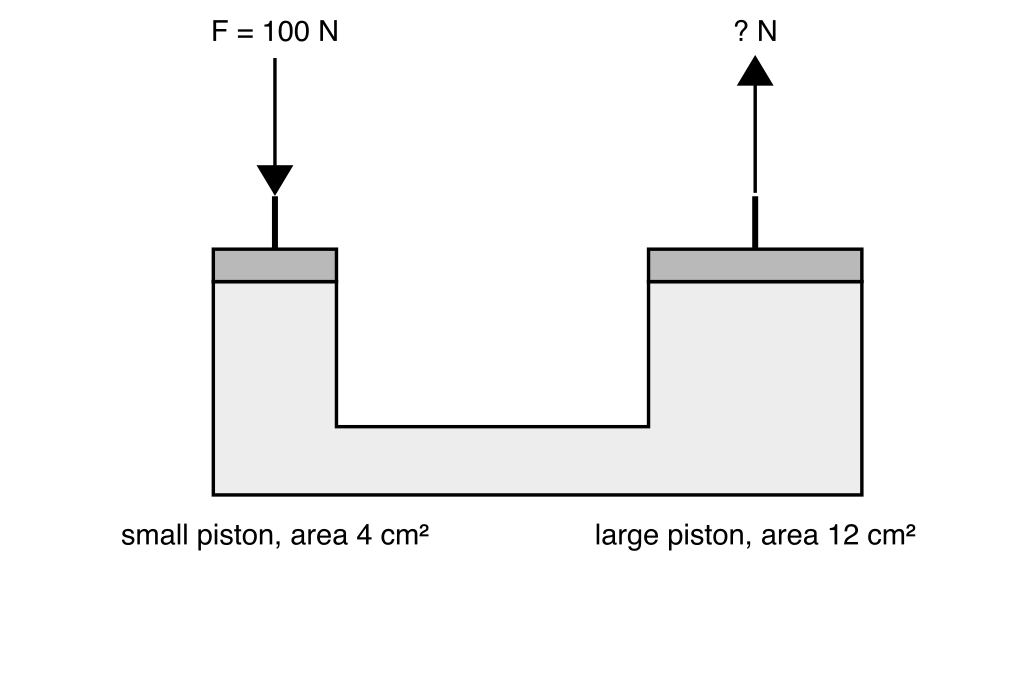
A hydraulic press has a small piston of area 4 cm² and a large piston of area 12 cm². If 100 N is applied to the small piston, what force is produced on the large piston?
Show answer and working
Answer: B. 300 N. Pascal's principle: F2 = F1 * (A2 / A1) = 100 * (12 / 4) = 300 N.
Question 24
Which tool is most appropriate to turn a hex-head bolt?
Show answer and working
Answer: D. socket wrench. A socket wrench is the standard tool for this task.
Question 25
Which of these materials expands the most when heated the same amount?
Show answer and working
Answer: C. aluminum. Aluminum has a higher coefficient of thermal expansion than steel, glass, ceramic, or concrete.
Question 26
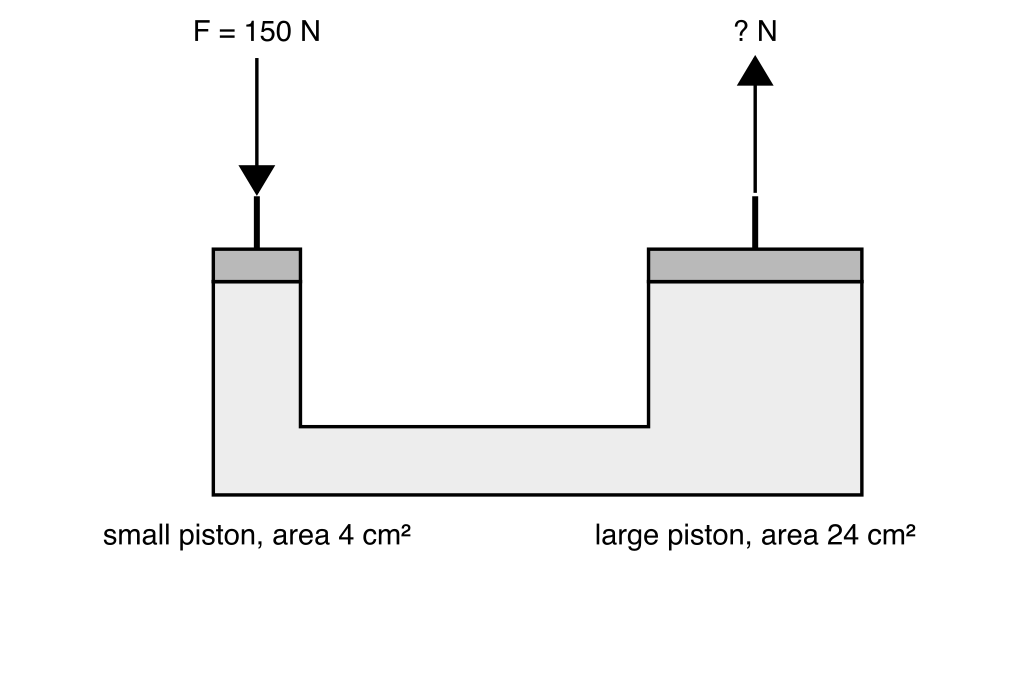
A hydraulic press has a small piston of area 4 cm² and a large piston of area 24 cm². If 150 N is applied to the small piston, what force is produced on the large piston?
Show answer and working
Answer: A. 900 N. Pascal's principle: F2 = F1 * (A2 / A1) = 150 * (24 / 4) = 900 N.
Question 27
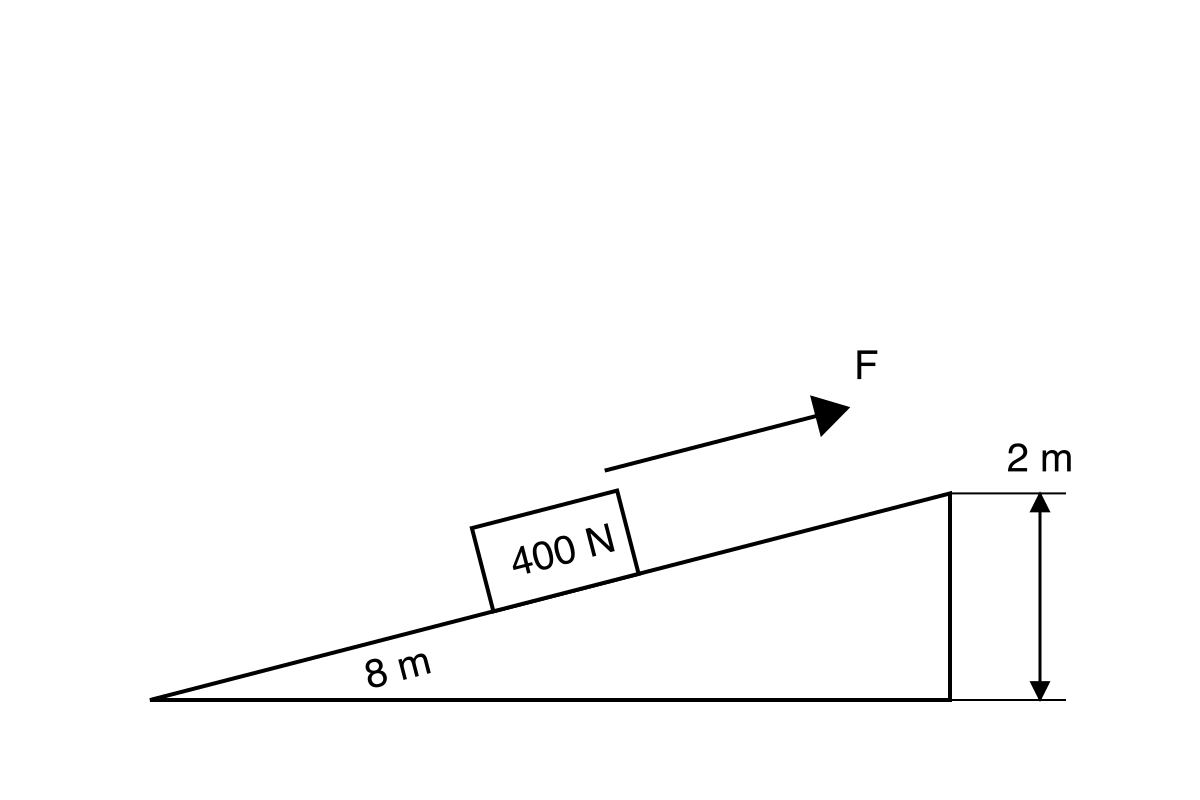
A frictionless inclined plane is 8 m long and 2 m high. A cart weighing 400 N is pushed up the ramp. What force is needed parallel to the ramp surface?
Show answer and working
Answer: B. 100 N. Force on a frictionless ramp equals weight times height divided by length: 400 * 2 / 8 = 100 N.
Question 28
A block and tackle system with 3 rope segments supporting the load is used to lift a 500 N weight. Ignoring friction, how much effort is required? Round to the nearest newton.
Show answer and working
Answer: F. 167 N. Mechanical advantage equals the number of supporting rope segments, so MA = 3. Effort = load / MA = 500 / 3 = 166.67 N, so 167 N to the nearest newton.
Question 29
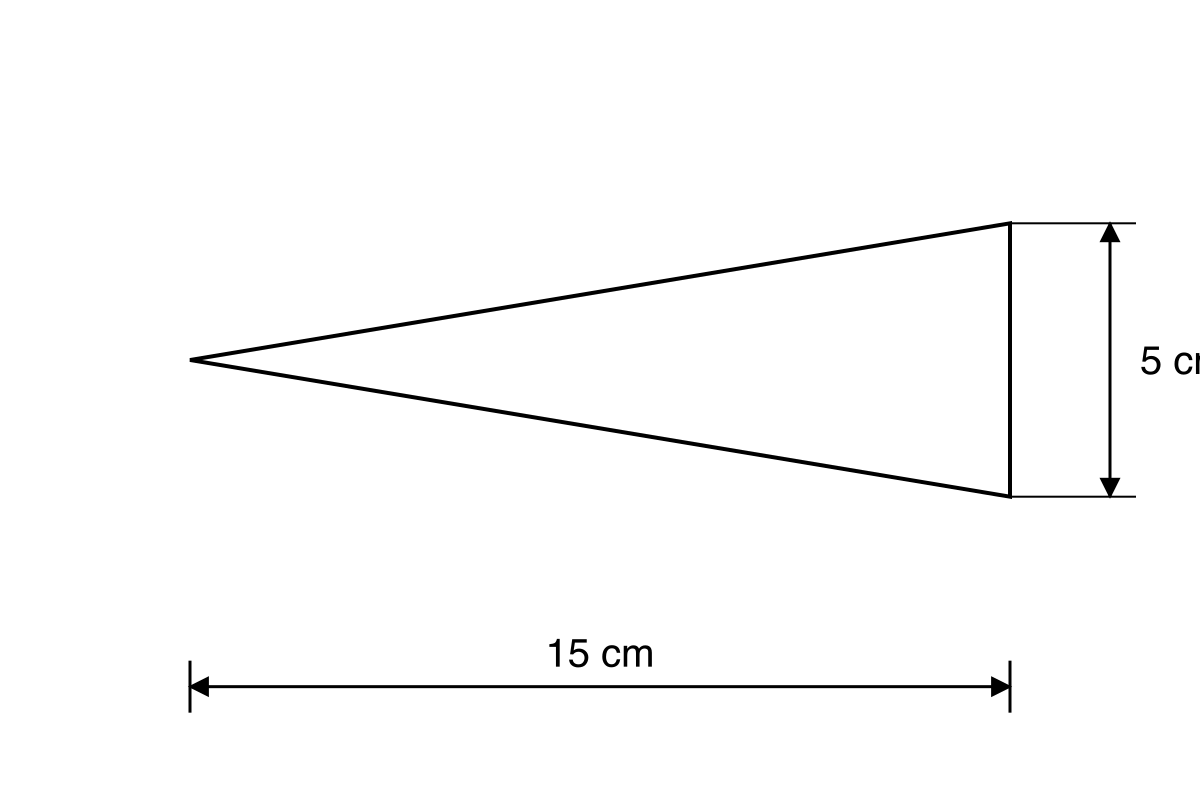
A wedge has a length of 15 cm and a thickness at its wide end of 5 cm. What is the mechanical advantage of this wedge?
Show answer and working
Answer: A. 3.0. Mechanical advantage of a wedge equals length divided by thickness: 15 / 5 = 3.0.
Question 30
A concave (curved inward) mirror is used to:
Show answer and working
Answer: C. focus parallel rays of light to a single point. Concave mirrors converge parallel incoming light rays at the focal point.
Question 31
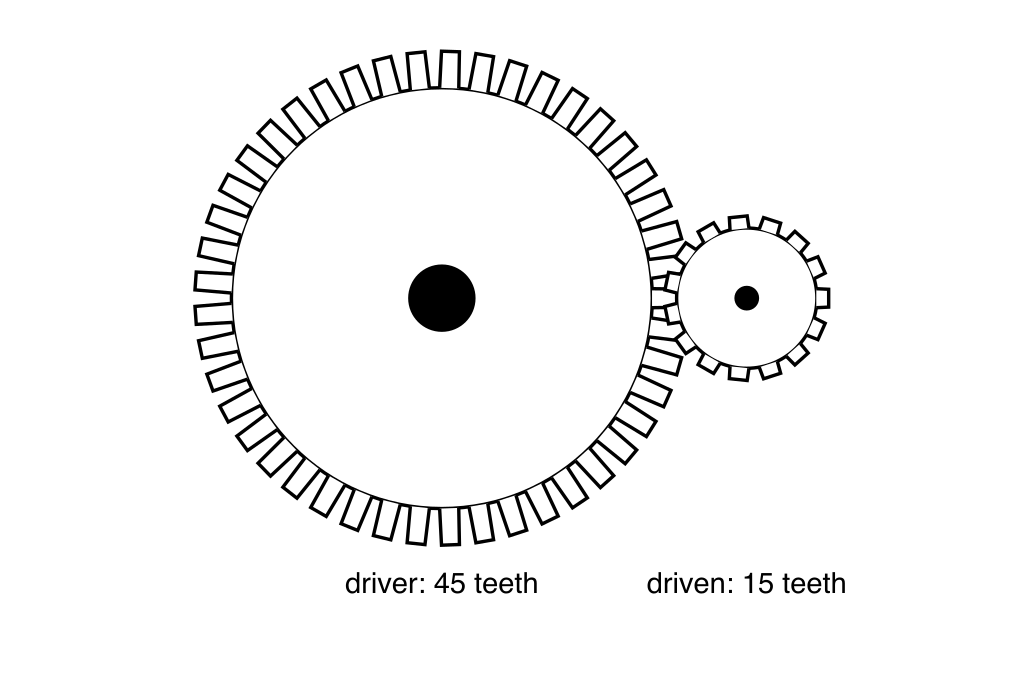
Two meshed gears are shown. The driver gear has 45 teeth and the driven gear has 15 teeth. What effect does this have compared to connecting them 1 to 1?
Show answer and working
Answer: B. decreases torque and increases speed. When a smaller driver meshes with a larger driven gear, torque increases and speed decreases in the ratio 45/15. When a larger driver meshes with a smaller driven gear, the reverse happens.
Question 32
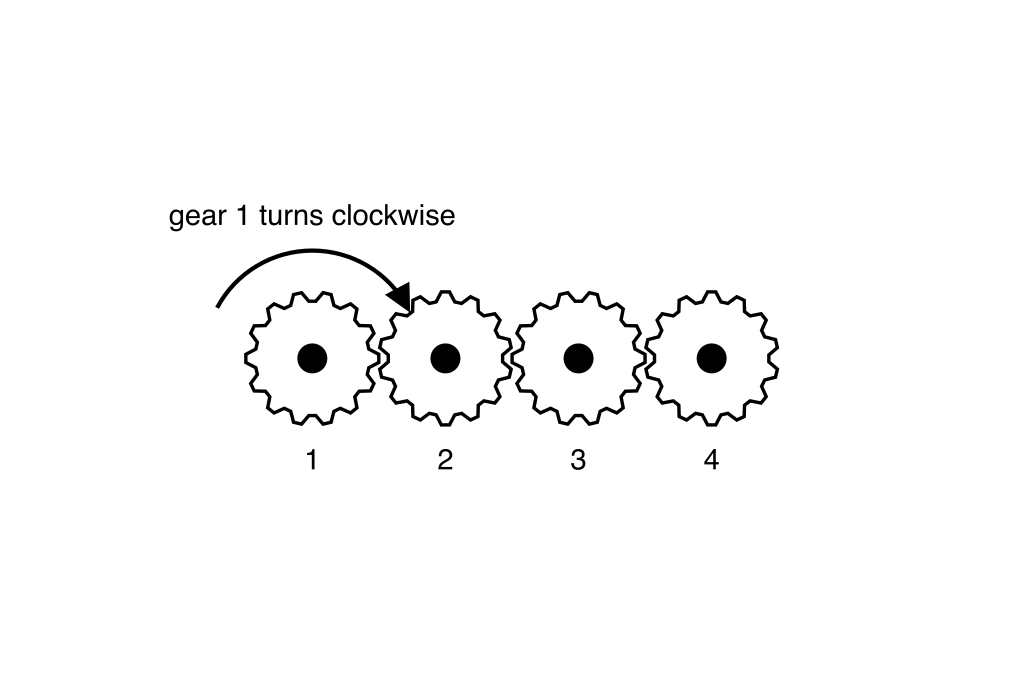
A chain of 4 meshed gears lies in a row. The first gear rotates clockwise. In what direction does the last gear rotate?
Show answer and working
Answer: B. counterclockwise. Each pair of meshed gears rotates in opposite directions. The last gear (position 4 of 4) rotates opposite to the first. Answer: counterclockwise.
Question 33
A block and tackle system with 2 rope segments supporting the load is used to lift a 200 N weight. Ignoring friction, how much effort is required?
Show answer and working
Answer: D. 100 N. Mechanical advantage of a block and tackle equals the number of supporting rope segments. Effort equals load divided by MA, so 200 / 2 = 100 N.
Question 34
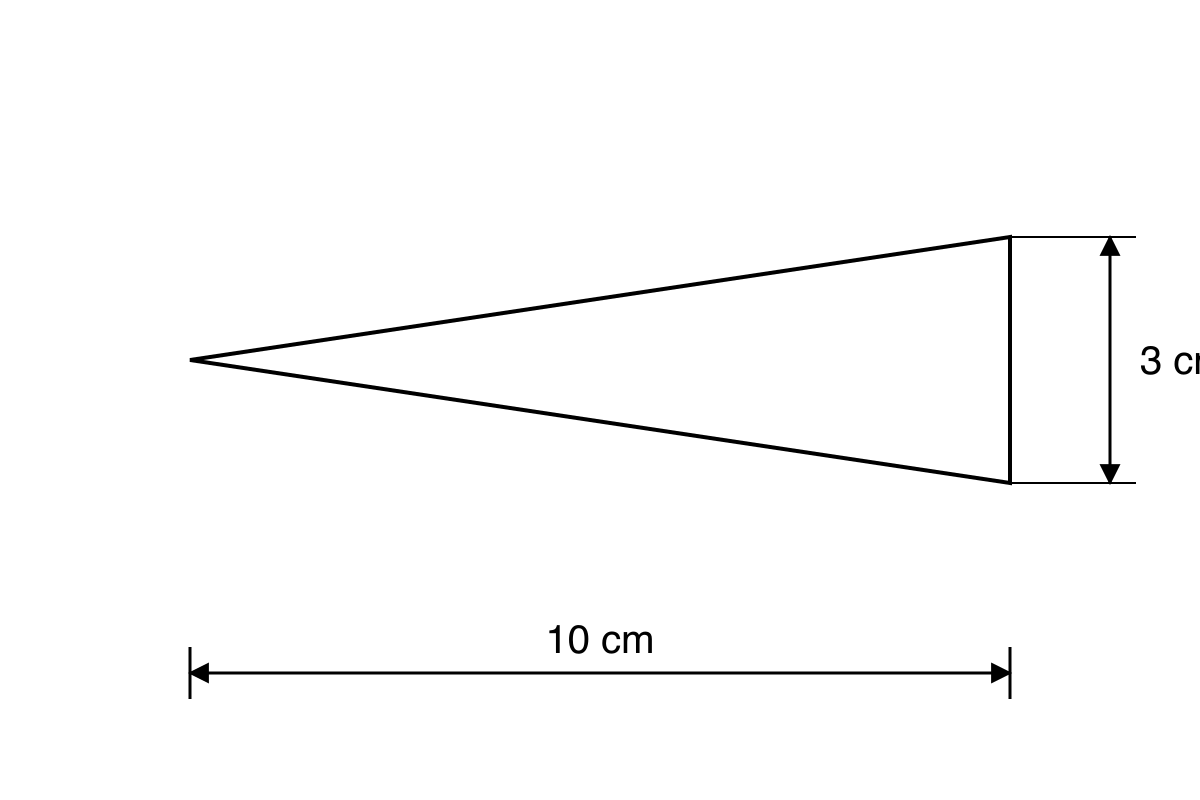
A wedge has a length of 10 cm and a thickness at its wide end of 3 cm. What is the mechanical advantage of this wedge?
Show answer and working
Answer: E. 3.3. Mechanical advantage of a wedge equals length divided by thickness: 10 / 3 = 3.3.
Question 35
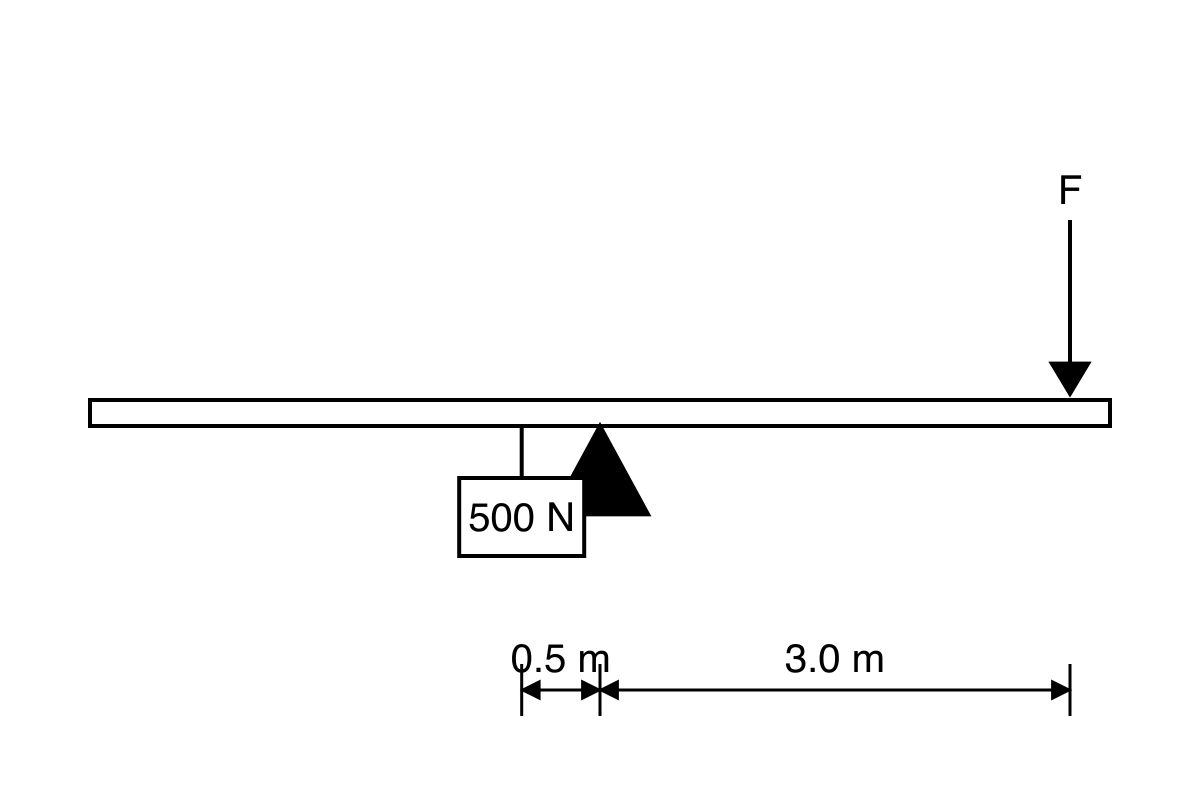
A first-class lever has its fulcrum in the middle. A load of 500 N sits 0.5 m from the fulcrum. The effort is applied 3.0 m from the fulcrum on the opposite side. Ignoring the lever mass, what effort lifts the load? Round to the nearest newton.
Show answer and working
Answer: B. 83 N. For a lever in balance, load * load_arm = effort * effort_arm. So effort = 500 * 0.5 / 3.0 = 83.33 N, so 83 N to the nearest newton.
Question 36
A simple closed circuit contains a battery and a bulb. If a second identical bulb is added in series, the brightness of each bulb will:
Show answer and working
Answer: C. decrease compared to the single-bulb circuit. Two bulbs in series share the voltage, so each receives less voltage than a single bulb and is dimmer.
How to use these tests well
Exam mode first. Your first timed score is your honest starting point.
Review every miss. After you finish, every answer opens in place: read the explanation for each miss and name the rule it uses (gear direction, lever balance, pressure and so on).
Study the rule, not the picture. The real test will show different pictures. The principles guide has each rule with a worked example.
Retake after a week in exam mode to check accuracy and pace together.
Frequently asked questions
Are these the real Bennett or Ramsay tests?
No. They are original practice tests written to match the published format of each test: 55 three-choice picture items in 25 minutes for Bennett-style, and 36 items in 20 minutes for Ramsay-style. Real test items are confidential.
Which practice test should I take?
Take the one that matches the test named in your invitation. If you do not know, start with the Bennett-style test: it covers the widest range of topics and the skills transfer to every other mechanical test.
Can I take the practice tests on my phone?
Yes, but diagrams are easier to read on a larger screen. Pearson recommends a desktop or laptop for the real BMCT-II, so practice the same way if you can.